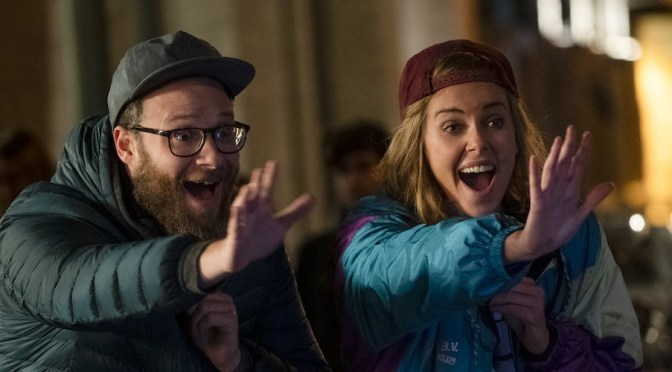
Jonathan Levine’s comedy set in the high stakes world of international diplomacy, Long Shot (B+), is equal parts shock and aw-shucks. Its central odd couple pairing is a meeting of hive minds and makes a wry statement about not always playing it safe, even in love and politics. Charlize Theron’s character is living in the bubble of a secretary of state role with eyes on the presidency when she encounters Seth Rogen’s schlubby ex-journalist turned speechwriter, and it’s a burst of unexpected laughs and chemistry as they embark on a world tour to save the planet, boost her likability polling and dodge a few unexpected hazards of the job. June Diane Raphael and O’Shea Jackson Jr. are supporting delights as the central duo’s witty advisors. If you’re not easily offended by vulgar sex and drug references, par for the course on the Rogen milieu, you’re in for one of the snappiest rom coms in quite a while. Theron steals the show as she reveals the vulnerability behind the statuesque veneer, especially in a sequence when she diffuses a global crisis while recovering from a night of particularly hardcore partying. Rogen enjoys his best role in years and gets to demonstrate his earnest side. The state of this union is quite satisfying.
Bring on the ballet of bombast! Chad Stahelski’s John Wick: Chapter 3 – Parabellum (B-) delivers more of what fans desire – the stoic Keanu Reeves as the titular retired hit man now with quite a bounty on his head, brutally graphic action sequences and elaborate fights and stunts staged against epic and ultra-cool set pieces. A few Oscar winners and nominees are thrown in the mix – Halle Barry, Laurence Fishburne and Angelica Huston chief among them – and none should expect a repeat nomination from this outing. Barry is particularly hit or miss. But for sheer propulsive action and energy, this flick brings the goods. Front-loaded with some of its best sequences including a fight in a library with books as weapons and a more straightforward showdown in an actual weapons store, the film ultimately gets a bit campy with elaborate lairs resembling Bond villain hideaways re-imagined by Max Headroom’s electronica DJ nephew. Following the rules and lore of the assassin underground becomes a bit puzzling, but by the time the travelogue has taken viewers from NYC to Casablanca and back, you realize it’s all just a big canvas for grotesquerie, kung fu and bloodsport. Nothing seems to slow down this earnest and absurd series.
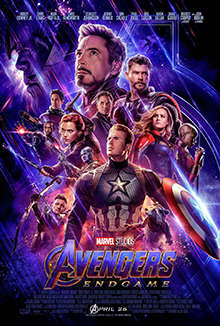
This is the fourth of the Avengers movies including nearly all Marvel Cinematic Universe characters.
Joe and Anthony Russo’s sprawling and satisfying superhero ensemble Avengers: Endgame (B+) is likely the most emotional of the Marvel series. It comes after the previous film’s conceit of killing off half the world’s population, and much of this installment addresses how people grieve and marshal the will to move forward. Two favorite characters have some stunning physical transformations which are subjects of consistent humor. Characters’ witty jabs at each other are a franchise hallmark, and these too are in ample supply. Action sequences are rare but quite CGI heavy and almost seem perfunctory in a film more centered on human bonds. Jeremy Renner, Mark Ruffalo, Chris Evans and Chris Hemsworth get many of the highlights in a sometimes overstuffed narrative. Come for the action; stay for the interaction.
A fun hybrid of Big and The Goonies, the DC Universe gets a lively dose of life and levity with the introduction of David F. Sandberg’s Shazam! (B). The film’s teen protagonist is grappling with new powers which cause him to toggle back and forth between awkward adolescence and transforming into a full-fledged adult superhero just as he joins a foster family with a bunch of precocious step-siblings. Asher Angel and Zachary Levi are superb and funny as the boy and his adult alter ego, respectively, and the film’s family includes Jack Dylan Graser as a cunning sidekick and Cooper Andrews as a lovable lug of a foster dad. The movie is aimed squarely at a family audience, despite a few early scares courtesy of Mark Strong’s viciously one-note villain and a bunch of beguiling CGI monsters. It’s a touch overlong, but the comedy, action and surprises pile high with fairly consistent success, and there are even a few moments of genuinely moving domestic drama. The movie creates characters for whom the audience can truly cheer in an environment largely well imagined. Expect the origin stories explored here to bring further marvels to DC.
Anyone who’s ever fantasized about having a twin has probably not seen many horror movies, because doppelgänger-dom is typically hell on earth when your double turns out to be trouble. In telling the suspenseful story of a privileged family facing off with unfortunate duplicate “others,” Jordan Peele’s Us (B+) peels back lots of layers about Modern America and reveals a complex and fascinating motion picture experience. The terror – set largely in West coast enclaves near a lake and a beach amusement park – is taut and the tone of unease singularly stirring, but the imaginative writer/director overreaches at times in his ambition to top Get Out with this unsettling sophomore effort. Lupita Nyong’o is simply fabulous in two distinct and challenging performances, but the problem with all the players is that allegorical characters aren’t that fundamentally interesting. Winston Duke doesn’t fare quite as well with a ho-hum husband character who can only be described as not wearing the pants much, literally or figuratively. Peele’s parade of timely topics spans from red state politics to the digital divide, from defanged authority figures to upper class malaise as clones endeavor to claw their way into the mainstream. A viewer could enjoy the fresh and breathless action without absorbing all the creative points of view the auteur is trying to convey. Ultimately although everything doesn’t add up in this creative piece of speculative fiction, film fans and horror enthusiasts will relish the journey. Peele’s undeniable style and subversive commentary about a country of haves and have nots is sly and smart.
Here’s a heroic hot take: It took 21 Marvel Cinematic Universe films for the creators to accomplish the hat trick of making it all not look so damn hard. Anna Boden and Ryan Fleck’s easy, breezy entertainment Captain Marvel (B+) places its plum protagonist in a hybrid mystery/prequel set in the ‘90s, and it reveals its plot and characters with leisurely delight and a stunning lack of urgency. The easygoing ensemble includes Brie Larsen being cool and collected in the title role, a special effects de-aged Samuel L. Jackson as ultra-chill Young Nick Fury, Ben Mendelsohn as a funny and super casual alien menace and a fetching feline stowaway low-key stealing its sequences. Aerial dogfighting, mind bending, light speeding and urban outrunning its way into the beloved comic book franchise, the movie builds atmosphere and drama without Thor sledgehammering or strange doctoring into too much needless complexity. The unfussy story: find yourself, find a secret charged object and set the stage for saving the universe. Plus it’s fairly woke in the casting and character departments. Mawkish supporting performances by Jude Law and Annette Bening are thankfully eclipsed by the nifty grunge-era songbook, splendid visuals and generous helpings of heart (Lashana Lynch and Akira Akbar are wonderfully warm as the captain’s surrogate family). The cast and crew clearly worked hard on this one, and it’s nice they put on a show without being so showy.
Acclaimed and criminally under-appreciated motion picture director William Friedkin is known for the gritty near-documentary reality he imbues in projects such as TheExorcist, The French Connection, Sorcerer, Cruising and Bug, so it’s fun to witness the man behind the movies sounding off about his approach. Francesco Zippel‘s FriedkinUncut (B) stitches together interviews with the titular director and many of his contemporaries about his place in history and examines sequences from the seminal works of his outrageous oeuvre. He’s a cunning subject with a POV on topics such as staging a great car chase, mounting an opera, embedding with priests and police for ultimate authenticity and getting deep in the heads of filmmaking pioneers. Quentin Tarantino, Ellen Burstyn, Willem Defoe and Francis Ford Coppola are among the most compelling storytellers about Friedkin’s influence. One of the greatest tricks Friedkin pulls is the art of filming with one simple take. Some behind the scenes and archival footage is better than others, but Zippel captures a compelling portrait of an exacting auteur.
Constructing a clever comedy requires a lot of bright component parts, and I suppose even Henrik Ibsen would marvel at the master builders behind this month’s blockbuster sequel! Veteran animator Mike Mitchell’s The LEGO Movie 2: The Second Part (B+), wisely written by the original film’s writer/directors Phil Lord and Christopher Miller, is a deft deconstruction of the walls governing plot and pacing. The result is a madcap bricks-and-mortar tour de force filled with hilarious highjinks, industry in-jokes and winning life lessons to be enjoyed by all ages. Chris Pratt (two roles), Elizabeth Banks (heroine) and especially Tiffany Haddish (shape-shifting emerging villain) shine in voice roles as the heroes face “Ar-mom-ageddon,” basically becoming toys thrown in the storage bin. The film blasts its ensemble of heroes and superheroes from a Mad Max style dystopia to an outer space world, with time travel and live action thrown in for good measure. It’s a pretty great musical too, following up “Everything is Awesome” with a variety of enjoyable new tunes including an earworm called “Catchy Song.” Just when you think you know where the plot is going, the creators have a few more bricks up there sleeve. There are so many great throwaway lines and creative gags that this second part may require a second viewing.
M. Night Shyamalan’s Glass (B) could also be called Superhero Erased as the always fascinating Sarah Paulson plays a conversion therapist to humans who believe they have superpowers. She turns her attention to a trio introduced in two films now considered the opening salvos of the “Eastrail 177 Trilogy”: Mr. Glass (Samuel L. Jackson), The Overseer (Bruce Willis) and The Beast plus his 23-member Horde (James McAvoy). Spencer Treat Clark, who played Willis’s son and Charlayne Woodard who played Glass’s mom in 2000’s Unbreakable and Anya Taylor-Joy as the abducted teen with a touch of Stockholm Syndrome in 2016’s Split round out the primary players in this mystery/thriller oddly devoid of quite the twists and turns the director usually has up his sleeves. Shyamalan puts the puzzle pieces together with joy and precision 90 percent of the time and a bit of clumsiness in the margins (his cameos in his movies, for instance, are almost always stupefyingly bad). The central trio of oddities each gets to showcase a brilliant bag of tricks, with Willis embodying silent heroism, Jackson devilish masterminding and McAvoy a whirling dervish of over-the-top schizophrenic characters. The pacing loses momentum in the denouement, but even a prolonged sequence which begs “get to the point already” gets ultimately explained. There are knowing references for devotees of the first films and enough soap opera twists and turns to catch up newcomers to the series. For a film called Glass, it could use a bit more sharpness and clarity. Although far from perfect, it certainly falls into the recommended works by this director.
This is the third film in what is unofficially called the Eastrail 177 Trilogy. See also these reviews of the other films, which were a bit better but together make an interesting observation about heroes and humanity: Unbreakable Split
Adam McKay’s genre-hopping Vice (B) is a distant cousin to Oliver Stone’s similarly dark comedic Natural Born Killers, admirable for creative storytelling about issues ripped out of the headlines but a bit confounding in what it’s intending to explore about its caricatures. Christian Bale is as good as you’ve heard brilliantly inhabiting the enigmatic role of Dick Cheney at various points in his life; he’s best in his quietest moments utterly lacking in expected reactions (his multiple heart attacks are treated like an occasional case of the hiccups). Amy Adams is magnificent as his deeply humanizing wife Lynn; she’s in fact his beating heart and just as ruthless. Many others in the ensemble simply feel like stunt casting, although Sam Rockwell does indeed make a spiffy W. The plot largely explores the build-up of the case for unilateral presidential (and strong vice presidential) authority and for the Iraq War. McKay so blissfully plays with the conventions of cinema – never trust a closing credit scroll or that a sequence won’t show up in iambic pentameter – that he often loses track of his central themes. In the film’s straight down the barrel of a shotgun portrayal of Wyoming’s famous son who stays pretty resolute in his principles and doesn’t care if you like him or not for it, you can find traces of character to please both sides of the aisle. But largely it’s a blistering assessment of power and an indictment of what the Cheney/Bush (or was it the other way around?) administration did with said power when they had it. There wasn’t a big record to clear up here, and the film doesn’t attempt to rose color it.
Mimi Leder’s On the Basis of Sex (B) takes a page out of the Spielberg Lincoln playbook by telling the story of a pivotal player in American life through the lens of a single subplot that succinctly illuminates an individual’s singular belief system. In this new movie, that person is Supreme Court Justice Ruth Bader Ginsburg (also chronicled in an awesome recent documentary RBG); and she’s splendidly embodied by Felicity Jones, playing the part with a quiet ferocity. Opposite a game Armie Hammer as her supportive lawyer husband and opposite old-fashioned adversaries played by the likes of Sam Waterston, Jones’s Ginsburg gets a lovely pedestal on which to shine. She’s most rousing in the moments in the margins, like when she notices she’s being fetishized by a make job interviewer or when she realizes her teen daughter has inherited her stubbornness. Her public performances lack some of their intended punch, but it’s hard not to get caught up in the case setting her destiny in action. The filmmakers were shrewd to choose a rather cut and dry example of discrimination on which to base the film’s central narrative; there were certainly pricklier scenarios they could have spotlighted which would have challenged the director and audience more. The storytelling is a bit predictable but still very lovingly rendered, and it’s a thrilling showcase of both actress and subject. In these times, there can hardly be enough films like this.
Although there’s nary a line as memorable as Gran Torino’s “Get off my lawn!” this time around, Clint Eastwood’s The Mule (B+) continues the actor/auteur’s loving curmudgeonly entreaty to the next generation to be kind to people even when the words coming from your mouth fail to express it, to take time for those you love even if you weren’t always great at this gesture in the past, to seek inner peace inside your family over the clarion calls of the outside world and to quit living on your damn cellphone. Eastwood as both director and leading man imparts his brilliant life lessons through an unconventional, deliberately paced tale and brings out lived-in performances from cast mates ranging from Bradley Cooper and Michael Peña as federal agents, Andy Garcia and Ignacio Serricchio as drug-lords and Dianne Wiest as the protagonist’s estranged ex-wife. The plot answers the question about what second career an old-school gardener can take in the internet age, and it’s not greeter at the local discount superstore. Eastwood’s enlistment as an inauspicious 90-year-old drug courier for a ruthless Mexican cartel provides the spry senior with a new job involving seeing the countryside, singing along to favorite radio oldies and procuring ample envelopes of cash, before the runs get increasingly dangerous. Many of Eastwood’s late-career (or is this mid-career?) films contemplate Big Issues, and he and screenwriter Nick Shenk (the man behind the words of Torino as well) do a splendid job balancing tangible tension and action, a marvelously relatable flawed hero and a small dusting of issues related to crime, class and race to be sorted out at your own leisure. Some mild quibbles include the hero’s occasional muttering of self-conscious soliloquy under his breath, inconsistencies about his spectrum of naiveté, some tender moments that get a little too treacly and pacing that could be a good bit tighter. But overall Eastwood’s metaphors are in full bloom, and he’s no passive rider in chronicling the American story. He’s still a major voice making movies that matter.





 Acclaimed and criminally under-appreciated motion picture director William Friedkin is known for the gritty near-documentary reality he imbues in projects such as The Exorcist, The French Connection, Sorcerer, Cruising and Bug, so it’s fun to witness the man behind the movies sounding off about his approach. Francesco Zippel‘s Friedkin Uncut (B) stitches together interviews with the titular director and many of his contemporaries about his place in history and examines sequences from the seminal works of his outrageous oeuvre. He’s a cunning subject with a POV on topics such as staging a great car chase, mounting an opera, embedding with priests and police for ultimate authenticity and getting deep in the heads of filmmaking pioneers. Quentin Tarantino, Ellen Burstyn, Willem Defoe and Francis Ford Coppola are among the most compelling storytellers about Friedkin’s influence. One of the greatest tricks Friedkin pulls is the art of filming with one simple take. Some behind the scenes and archival footage is better than others, but Zippel captures a compelling portrait of an exacting auteur.
 Constructing a clever comedy requires a lot of bright component parts, and I suppose even Henrik Ibsen would marvel at the master builders behind this month’s blockbuster sequel! Veteran animator Mike Mitchell’s The LEGO Movie 2: The Second Part (B+), wisely written by
 M. Night Shyamalan’s Glass (B) could also be called Superhero Erased as the always fascinating Sarah Paulson plays a conversion therapist to humans who believe they have superpowers. She turns her attention to a trio introduced in two films now considered the opening salvos of the “Eastrail 177 Trilogy”: Mr. Glass (Samuel L. Jackson), The Overseer (Bruce Willis) and The Beast plus his 23-member Horde (James McAvoy). Spencer Treat Clark, who played Willis’s son and Charlayne Woodard who played Glass’s mom in 2000’s Unbreakable and Anya Taylor-Joy as the abducted teen with a touch of Stockholm Syndrome in 2016’s Split round out the primary players in this mystery/thriller oddly devoid of quite the twists and turns the director usually has up his sleeves. Shyamalan puts the puzzle pieces together with joy and precision 90 percent of the time and a bit of clumsiness in the margins (his cameos in his movies, for instance, are almost always stupefyingly bad). The central trio of oddities each gets to showcase a brilliant bag of tricks, with Willis embodying silent heroism, Jackson devilish masterminding and McAvoy a whirling dervish of over-the-top schizophrenic characters. The pacing loses momentum in the denouement, but even a prolonged sequence which begs “get to the point already” gets ultimately explained. There are knowing references for devotees of the first films and enough soap opera twists and turns to catch up newcomers to the series. For a film called Glass, it could use a bit more sharpness and clarity. Although far from perfect, it certainly falls into the recommended works by this director.
 Adam McKay’s genre-hopping Vice (B) is a distant cousin to Oliver Stone’s similarly dark comedic Natural Born Killers, admirable for creative storytelling about issues ripped out of the headlines but a bit confounding in what it’s intending to explore about its caricatures. Christian Bale is as good as you’ve heard brilliantly inhabiting the enigmatic role of Dick Cheney at various points in his life; he’s best in his quietest moments utterly lacking in expected reactions (his multiple heart attacks are treated like an occasional case of the hiccups). Amy Adams is magnificent as his deeply humanizing wife Lynn; she’s in fact his beating heart and just as ruthless. Many others in the ensemble simply feel like stunt casting, although Sam Rockwell does indeed make a spiffy W. The plot largely explores the build-up of the case for unilateral presidential (and strong vice presidential) authority and for the Iraq War. McKay so blissfully plays with the conventions of cinema – never trust a closing credit scroll or that a sequence won’t show up in iambic pentameter – that he often loses track of his central themes. In the film’s straight down the barrel of a shotgun portrayal of Wyoming’s famous son who stays pretty resolute in his principles and doesn’t care if you like him or not for it, you can find traces of character to please both sides of the aisle. But largely it’s a blistering assessment of power and an indictment of what the Cheney/Bush (or was it the other way around?) administration did with said power when they had it. There wasn’t a big record to clear up here, and the film doesn’t attempt to rose color it.
 Mimi Leder’s On the Basis of Sex (B) takes a page out of the Spielberg Lincoln playbook by telling the story of a pivotal player in American life through the lens of a single subplot that succinctly illuminates an individual’s singular belief system. In this new movie, that person is Supreme Court Justice Ruth Bader Ginsburg (also chronicled in an awesome recent documentary
 Although there’s nary a line as memorable as Gran Torino’s “Get off my lawn!” this time around, Clint Eastwood’s The Mule (B+) continues the actor/auteur’s loving curmudgeonly entreaty to the next generation to be kind to people even when the words coming from your mouth fail to express it, to take time for those you love even if you weren’t always great at this gesture in the past, to seek inner peace inside your family over the clarion calls of the outside world and to quit living on your damn cellphone. Eastwood as both director and leading man imparts his brilliant life lessons through an unconventional, deliberately paced tale and brings out lived-in performances from cast mates ranging from Bradley Cooper and Michael Peña as federal agents, Andy Garcia and Ignacio Serricchio as drug-lords and Dianne Wiest as the protagonist’s estranged ex-wife. The plot answers the question about what second career an old-school gardener can take in the internet age, and it’s not greeter at the local discount superstore. Eastwood’s enlistment as an inauspicious 90-year-old drug courier for a ruthless Mexican cartel provides the spry senior with a new job involving seeing the countryside, singing along to favorite radio oldies and procuring ample envelopes of cash, before the runs get increasingly dangerous. Many of Eastwood’s late-career (or is this mid-career?) films contemplate Big Issues, and he and screenwriter Nick Shenk (the man behind the words of Torino as well) do a splendid job balancing tangible tension and action, a marvelously relatable flawed hero and a small dusting of issues related to crime, class and race to be sorted out at your own leisure. Some mild quibbles include the hero’s occasional muttering of self-conscious soliloquy under his breath, inconsistencies about his spectrum of naiveté, some tender moments that get a little too treacly and pacing that could be a good bit tighter. But overall Eastwood’s metaphors are in full bloom, and he’s no passive rider in chronicling the American story. He’s still a major voice making movies that matter.