Jodie Foster plays an idiosyncratic American psychiatrist in Paris and flexes her remarkable language skills in Rebecca Zlotowski’s largely unremarkable dramatic thriller A Private Life (C). While the protagonist’s tightly knit world begins to unravel after the sudden death of a patient, the viewer can’t help but contemplate the lead actress in full French-speaking mode attempting to also emote within the confines of a fairly flimsy and meandering mystery. Her character is seen alternately puffing cigs, gulping wine or muttering “merde” while en route to each subsequent scene. Zlotowski doesn’t give Foster much to work with in terms of story, ensemble or even relics of modernity. For every reference to long Covid grounding the tale in modern times, there are countless conversations about missing cassettes and a tense trip to the card catalogue. The drab cinematography and dreary atmosphere fail to give the film the pick-me-up that might have helped hasten the pace. I kept waiting for my seventh grade French class teacher to invite us all to a “surprise-partie.” There’s one sequence of hypnosis that almost takes viewers to an alternate otherworld, but the film largely remains steeped in potboiler tropes without that veritable pot ever boiling. One sexy subplot goes absolutely nowhere; another goes further than one would wish. Thankfully there are a few anticipated moments of joie de vivre in the final act.
Strap onto your seats, not out of a promise of actual cinematic intensity, but because only literal harnesses or handcuffs will keep anticipatory viewers sufficiently locked in for this misbegotten A.I. justice thriller. Timur Bekmambetov’s Mercy (F) tethers career-worst performances by both Chris Pratt and Rebecca Ferguson to a belabored plot, accompanied by a constant countdown which incessantly reminds viewers it’s almost over. The story places Pratt in a literal chair from which he must defend himself against a crime of passion before Ferguson’s monotone cyber judge with the assistance of computer files, municipal cloud recordings, location records and phone-a-friend technologies. This data dump boasts all the thrills of overnight mainframe maintenance. None of the film’s preposterous characters bears resemblance to any found naturally in reality, and the stakes are rotten from the get-go. The film’s format robs a generally charismatic actor of his charm and the actress of her nuance. Even a final act showdown is thwarted by mind-numbing dialogue and baffling answers to an already shaky thesis. This hour and a half of cheesy effects and weasely affectations is akin to an escape room where every participant simply wants out. It redefines “edge of your seat” in that you’ll find yourself rearing to slither away to any other place.
What happens when a battle-tested boy, an isolated physician, a naked and sedated alpha zombie and a gang of miscreants encounter one another for the second part of an inventive film trilogy in a long-running series? It’s bloody interesting, when that film installment is Nia DaCosta’s 28 Years Later: The Bone Temple (B). Ralph Fiennes’ kindly physician character takes center stage, and his “bone temple” memorial to lost lives in an uncertain future becomes a veritable amphitheater for this movie’s showdown with some unlikely villains. This film amps up the gore, brutality and existential dread about true evil in the world, and Fiennes anchors the film with grace notes of humanity mixed with a hint of the unhinged. As the teen who came of age in the previous installment, Alfie Williams is again wonderfully emotive but a little sidelined in a majority of the story. Jack O’Connell is dynamite as a menacing leader of a band of renegades including an effective Erin Kellyman. Even Chi Lewis-Parry brings humanity to his hulking infected character. This latest trilogy upends many of the tropes of the undead genre, with conversation and contemplation featured more often than straightforward action. It’s still very engrossing, even if the myth-making in Danny Boyle’s previous movie was more revelatory than the religious angles of DaCosta’s. This is a delightful and delicate mash-up of genres and one of the most offbeat Hollywood tentpole films to be released in some time. Again, it’s exciting and insightful.
We are on the precipice of a very early Golden Globes weekend this Sunday (before Oscars, months away on 3/15/26 – and oh, do we have a viewing party in the works down at Trilith come the ides of March!) Expect parental anxiety and monsters (both literal and human!) to reign supreme for the wins! Timothee Chalamet as a ping pong champion (“Marty Supreme” now a hit in theatres), Michael B. Jordan as twin gangsters fighting the supernatural (“Sinners”), Rose Byrne and Jesse Buckley as parents facing unbearable crucibles (“If I Had Legs I’d Kick You” and “Hamnet”), Jacob Elordi as a patchwork creature (“Frankenstein” on Netflix) and Amy Madigan wielding witchery and micro-bangs (one of my faves, “Weapons” now on HBO Max) are my predictions to triumph. Brazil’s “Secret Agent” could also be an acting spoiler, with big fans in the international voting wing. Expect “One Battle After Another” and “Sinners,” both now on HBO Max for those catching up, to clinch top prizes. Nikki Glaser hosts Sunday night on CBS and Paramount+. Expect it all to be as “Golden” as The Outsiders in their heyday or the ubiquitous “K Pop Demon Hunters” song.
Dueling piano players, hit makers of the karaoke leaderboard and all-out tribute bands rarely get their proper due in the limelight. But get ready for the latter musical misfits to enjoy cinematic comeuppance. The true life story of two down-on-their-luck musicians who perform in a Neil Diamond cover band in grunge-era Milwaukee, Craig Brewer’s Song Sung Blue (B+) is one of those movies they just don’t make anymore, the idealistic tale of two good but imperfect souls overcoming incredible odds to make amazing music and life together. A jubilant Hugh Jackman and a resplendent Kate Hudson co-star as Lightning & Thunder, two halves of a novelty act that doubles as an excuse for mutual burgeoning love interests. The film is unabashedly melodramatic and formulaic, and yet it still hits all the right notes to keep viewers deeply engaged. Hudson in particular is wonderful in her role, acting and singing her way through a crucible of challenges as a salt-of-the-earth everywoman. It’s a triumph for this popular actress. Brewer stages montages such as “Sweet Caroline,” “Play Me” and “Holly Holy” with gregarious gusto, with several standout montages mirroring stage life and behind the scenes travails. The film is the genuine article, with legitimately nice people being good to one another and lifting each other up in community. This is an enjoyable crowd pleaser successfully turning on the heart lights of communal multiplex patrons everywhere.
There goes Disney again with the preposterous notion that all should be equal; that’s right, follow-up features generally aren’t. Jared Bush and Byron Howard’s Zootopia 2 (B-) poses the premise that second-class citizen reptiles should be regarded equally in the pantheon of all-animal new urbanism. The spry duo of Ginnifer Goodwin and Jason Bateman returns as undercover cops in bunny and fox form, respectively, joined in the fun and puns by the amusing voice talents of Quinta Brunson, Fortune Feimster and Ke Huy Quan. The fast-paced action is fairly nonstop with few amazing animations or detours to distinguish the sequel from the original. Still, as global blockbusters go, this proves pretty entertaining for both kids and adults (including the overall Chinatown vibe and The Shining references) and gets a marginal recommendation as a family outing.
Those wondering if the third film in the saga about clashes between humans and blue alien creatures would live up to the epic stature of its predecessors can hold their collective Pandora breath. Despite a lush rendered environment, James Cameron’s latest opus Avatar: Fire and Ash (C) is just as head-scratching in its mediocrity as the two films before it. In some ways this one’s a little worse as it flagrantly rehashes many of the themes in the last bloated entry. Rarely has so much meticulous craft been invented at the service of such benign characters and pedantic a storyline. Riffs on loss, conflicts with warring tribes and meddling humans, meditations on the nobility of sea creatures and even Biblical parables about fathers and surrogate sons don’t make this entry any better. The soggy story and screenplay extinguish most of the intrigue here, with flickers of action sequences filling the ample running time between the senseless sermonizing. None of the CGI-coated actors get much of a showcase as this glorified screen saver parades before us.
Timothy Chalamet’s titular character in Josh Safdie’s fresh, funny and mightily maximalist Marty Supreme (A) is ostensibly a champion table tennis player in 1950s America, but more than that, he’s a big talker of the first order. In successive sequences of powerful propulsion, the ambitious young man asserts one prattle after another in his pursuit of his own form of gamified survival and world domination. Call it hustle memory as the upstart fakes it or takes it ‘til he makes it. In a form of art meets reality, the celebrity on the rise behind the commanding central performance creatively markets his film product in every manner possible or practical, and Safdie and collaborators bottle this delirious derring-do in consecutive kinetic sequences of dramatic dialogue and action. Chamalet successfully carries the burden of his toxic central character on solid shoulders with rounds of vigor, charisma, gusto and bravura emitting from his agile acting pinwheel; even if you don’t like his cunning character, you can’t help giving him points for pulling out all the stops. One moment he’s hawking women’s shoes and the next he’s selling international dignitaries on ways to change the course of human destiny. Even if it’s half true, it’s tough not to be swept up in the bombast as he ping pongs through hyperlocal and global adventuring. This talky epic may suffocate some viewers in its angst and anxiety producing power, but it proves consistently winning and watchable fun. There’s hardly breathing room for any other acting surrounding Marty’s supremacy, but Gwyneth Paltrow and Odessa A’zion contribute some graceful screen time as a luminous movie star and scrappy neighborhood gal, respectively, who both become love interests and land mines in the protagonist’s vision quest. Daniel Lopatin’s infectious music is unstoppable in its rise, interlaced with dreamy pop music from decades to come. Darius Khondii’s stunning period-era cinematography is you-are-there visceral. In addition to his assured direction, Safdie is also co-writer and co-editor with Ronald Bronstein, and together they fashion a powderkeg of distinctly American invention and resilience in the pursuit of greatness. It’s an embarrassment of riches with such a handsome production design, breakneck pace and zinger-filled dialogue and an awesome reason to support your local cineplex.
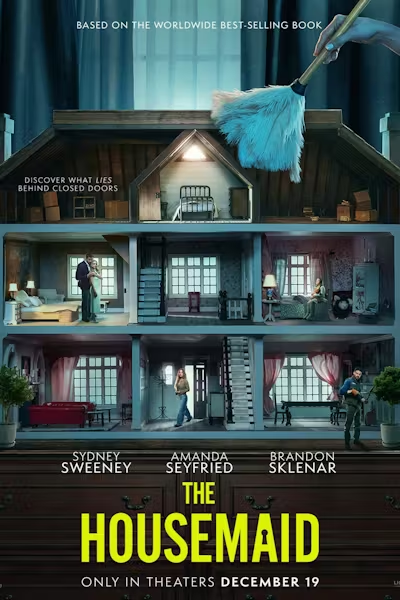
A trio of spellbinding performances anchors a sometimes successful new domestic thriller, Paul Feig’s The Housemaid (B-). The twisty film follows a young woman with a troubled past, played by a deadpan and eerily relatable Sydney Sweeney, hired as the live-in help for a wealthy family, the delightfully cuckoo Amanda Seyfried and smoldering hubbie Brandon Sklenar. Their seemingly idyllic life unravels when it becomes quickly clear the household hides some scandalous Stepford-level secrets. Rebecca Sonnenshine’s screenplay based on the 2022 Freida McFadden novel popularized on BookTok mostly delivers on the delicious conceits of the three-hander, although it pushed toward a hopeful level of campiness not fully realized. Both women are glorious in their equally emotional and physical roles, and Sklenar proves a powerful screen presence in his scenes opposite each. The movie is not overly scary or suspenseful and takes its time introducing grislier themes. It works best when snarkiness or sexiness rise to the occasion. The film’s crafts are top-notch with Naomi Munro’s posh production design and John Schwartzman’s cinematography providing a bountiful take on a garishly hypnotic and vaguely Hitchcokian suburbia. The film should have been more judiciously edited but is largely the kind of fun throwaway thriller we don’t get enough of at the movies these days.
Eva Victor announces her arrival on the independent cinema scene as sardonic writer, star and director of the tragicomic Sundance sensation Sorry, Baby (B+); and her raw, fragmented plot structure makes for a sneakily emotional knockout of an experience, set in and around New England academia. Given much of the narrative covers heavy subject matter, Victor wisely frames the film and starts it as a friendship story opposite the magnificent Naomi Ackie, with Victor’s grad student character’s signature wit and idiosyncratic outlook remaining center stage throughout, even during dark passages. The interplay between these two is hilarious and healing. The nonlinear story takes viewers through the protagonist’s variety of memories both playful and painful and sometimes overtly ordinary. It doesn’t depict the sexual assault that forever changed her life: in fact, it’s the clever scrambling of events that makes the film’s emotional and physical violations so potent and powerful. Victor’s unflinching near-soliloquy about the story’s inciting incident, tucked tenderly in a middle passage, is one of the best sequences captured on film this year. Reliable trauma film fixture Lucas Hedges and an adorable gray tabby kitten (not to worry, the feline survives) are enjoyable in small emotional support roles. It’s ultimately an uplifting and moving film about caring for one another from a perspective of someone who tells it like it is. Via these “Victorious” authorial hands, this movie is an apt exploration of how every day can be so much better than our worst day.
A peculiar mix of existential road trip journey and deeply human dystopian drama, this year’s international film contender from Spain is a curiosity made more memorable through the trance of its soundscape. Oliver Laxe’s transfixing drama Sirat (B-) is a puzzling tale set in Morocco rave culture and follows desert denizens through a series of raw, uncompromising and disturbing episodes. The main throughline is a quest for a missing girl, but a variety of congregating characters contribute to a narrative about people facing their limits. The ensemble of actors plays its respective parts with no clear standout (Nashville it ain’t), but Kangding Ray (aka David Letellier) is the film’s MVP providing the atmospheric electronic score. The movie’s high points are visceral, experimental and observant as it plays witness to earth’s people as playthings and random occurrences as part of cosmic universal truths. The film nearly begs for concessions served in a dime bag. Like many who may imbibe and watch this, it loses significant steam toward the end.
A luxury nine-screen cinema — introducing a next-generation moviegoing experience to the region — is beginning shows this weekend in a haven known for moviemaking and a creative environment nourishing storytelling.
The newest outpost of Southeastern chain Georgia Theatre Company, Inc. (“GTC Cinemas”) is opening at the region’s newest state-of-the-art entertainment and special event venue Trilith LIVE, located at 165 Trilith Parkway in Fayetteville, Georgia.
The new multiplex of auditoriums range from the GTX Georgia Theatre Extreme room which currently houses the Avatar sequel to smaller viewing rooms for independent or artier fare.
The new Georgia Theatre Company cinema promises a moviegoing experience unlike any other. It will feature a revolutionary Samsung Onyx screen for crystal-clear LED brilliance and the GTX Premium Large Format auditorium for an immersive audio-visual experience.
Complete with full-service bars, the theater is positioned to become a premier destination for unforgettable nights out. Businesses or groups can also reserve auditoriums for events.
“We are thrilled to partner with Trilith to introduce a cinema experience that sets a new standard for moviegoers,” said Bo Chambliss, president of Georgia Theatre Company. “We are not just opening a new theatre; we are creating an unparalleled entertainment destination. This cinema is a testament to our commitment to delivering the magic of the movies, and we can’t wait for the community to experience it with us.”
Among the many features of the new theatre are “Bargain Tuesdays” with discounted tickets. With all the talk about the relevance of movie theatres for shared experiences and a 2026 ahead with new tentpole Steven Spielberg and Christopher Nolan movies and new Shrek, Toy Story and Avengers blockbusters, it will be a watershed year for major event spectacles.
We’ll share more news as our Silver Screen Capture team pays its first visit to Trilith Cinemas for Friday, December 18 programming.
Get to KnowTrilith LIVE!
Trilith LIVE, the region’s newest state-of-the-art entertainment and special event venue recently announced its grand opening season of live events, set to ignite Fayetteville with a vibrant slate of concerts, family shows, corporate meetings and community events. The grand opening season gets fully underway in 2026 with a variety of entertainment events.
This multi-faceted development promises to transform the region’s cultural landscape, offering an unparalleled array of live performances, cinematic experiences and unique events. The project has attracted a dynamic mix of touring artists, television productions, corporate meetings and conventions that will strengthen Fayette County, Georgia’s position as a hub for economic development. Many have already been enjoying live game shows and reality shows in the venue’s live sound stages.
“Trilith LIVE is more than just a venue; it’s a new epicenter for arts, culture and entertainment in the region,” said Matt McClain, executive director & general manager of Trilith LIVE. “We’ve built a space with state-of-the-art technology and incredible flexibility to attract a diverse lineup of live entertainment and special events. We are incredibly excited to open our doors and provide unforgettable experiences for this community and beyond.”
Engineered for adaptability, the venue features an immersive sound system, massive LED walls and a full broadcast suite. With a capacity of up to 2,800, it will host everything from major concerts and performing arts to corporate events and banquets.
Trilith LIVE’s inaugural live entertainment season has a lineup that caters to all audiences, including the following events announced so far:
Gabby’s Dollhouse Live! – Jan. 15, 2026
Jackie Hill Perry – Feb. 7, 2026 (sold out)
38 Special – Feb. 13, 2026
An Evening with October London & Lalah Hathaway – Feb. 14, 2026
Popovich Comedy Pet Theatre – Feb. 17, 2026
Dwight Yoakam – Feb. 20, 2026
Hairball – Feb. 27, 2026
Rick Braun – Feb. 28, 2026
Home Free – Highways & High Seas Tour, March 20, 2026
Little River Band – March 28, 2026
Legends of Laughter: Sommore, Earthquake, Lavell Crawford and Don DC Curry – April 11, 2026
Michael W. Smith – April 18, 2026
Handyman HalComes to Town – April 24, 2026
Jeffrey Osborne – May 2, 2026
Randy Travis – The More Life Tour with guest vocalist James Dupre’ – May 22, 2026
Trilith LIVE’s corporate gatherings and community events include the following events announced so far:
Etherio Company Meeting – Dec. 15, 2025
City of Fayetteville CPR Training – Dec. 17, 2025
Fayette County Development Authority Meeting – Jan. 20, 2026
Fayette County Intergovernmental Business Outlook – Feb. 12, 2026
CREW Leadership Summit – Feb. 26, 2026
Georgia Chamber of Commerce Conference – March 11, 2026
Fayette County Board of Realtors Awards Gala – March 21, 2026
Fayette PRC Spring Gala – March 27, 2026
Harp’s Crossing Christian Academy Annual Fundraising Gala – April 30, 2026
Faith & Institutional Investing Summit – June 4-5, 2026
Hitachi Construction Machinery Americas Conference – July 21-23, 2026
State of the Industry hosted by Trilith Studios – Oct. 22, 2026
Two Sparrows Village Bird Bash – Nov. 13, 2026
For more information about these events at Trilith LIVE, please visit the facility’s website.
Passion City Church at Trilith LIVE
Adding to the community’s vibrant spirit, Passion City Church will soon make Trilith LIVE its newest location. Known for its mission centered on the glory of God, radical grace and extravagant worship, the church will bring its message to Trilith LIVE to further enrich the diverse fabric of Trilith and underscore the development’s commitment to fostering connection and shared experiences.
“Passion City Church is thrilled to make Trilith LIVE our home—a place to gather as followers of Jesus, build strong community, and host city-wide events,” said Louie Giglio, global pastor of Passion City Church. “It will take all of us, through collective generosity, to bring this vision to life and create a space where we worship.”
For more information about Passion City Church, please visit its website.
About The Town of Trilith
The Town of Trilith, adjacent to Trilith Studios, is a 235-acre master-planned residential and mixed-use project in south metro Atlanta. Envisioned as a gathering place for creatives, artists, storytellers and makers, this European-inspired community will include 750 single-family homes, 600 multifamily lofts, 300 hotel rooms and 270,000 square feet of restaurants, retail, office, and commercial space. The residential neighborhoods at Trilith comprise the largest geothermal community in the United States, with 51% of the development dedicated to green space that is currently home to more than 1,000 trees. Upon completion, residents will have access to 15 miles of nature trails, 54 acres of forest, 19 landscaped parks, and one of the most sophisticated and welcoming dog parks in the world. For more information about Town of Trilith, please visit its website.