I've reviewed films for more than 35 years. Current movie reviews of new theatrical releases and streaming films are added weekly to the Silver Screen Capture movie news site. Many capsule critiques originally appeared in expanded form in my syndicated Lights Camera Reaction column.
Dueling piano players, hit makers of the karaoke leaderboard and all-out tribute bands rarely get their proper due in the limelight. But get ready for the latter musical misfits to enjoy cinematic comeuppance. The true life story of two down-on-their-luck musicians who perform in a Neil Diamond cover band in grunge-era Milwaukee, Craig Brewer’s Song Sung Blue (B+) is one of those movies they just don’t make anymore, the idealistic tale of two good but imperfect souls overcoming incredible odds to make amazing music and life together. A jubilant Hugh Jackman and a resplendent Kate Hudson co-star as Lightning & Thunder, two halves of a novelty act that doubles as an excuse for mutual burgeoning love interests. The film is unabashedly melodramatic and formulaic, and yet it still hits all the right notes to keep viewers deeply engaged. Hudson in particular is wonderful in her role, acting and singing her way through a crucible of challenges as a salt-of-the-earth everywoman. It’s a triumph for this popular actress. Brewer stages montages such as “Sweet Caroline,” “Play Me” and “Holly Holy” with gregarious gusto, with several standout montages mirroring stage life and behind the scenes travails. The film is the genuine article, with legitimately nice people being good to one another and lifting each other up in community. This is an enjoyable crowd pleaser successfully turning on the heart lights of communal multiplex patrons everywhere.
There goes Disney again with the preposterous notion that all should be equal; that’s right, follow-up features generally aren’t. Jared Bush and Byron Howard’s Zootopia 2 (B-) poses the premise that second-class citizen reptiles should be regarded equally in the pantheon of all-animal new urbanism. The spry duo of Ginnifer Goodwin and Jason Bateman returns as undercover cops in bunny and fox form, respectively, joined in the fun and puns by the amusing voice talents of Quinta Brunson, Fortune Feimster and Ke Huy Quan. The fast-paced action is fairly nonstop with few amazing animations or detours to distinguish the sequel from the original. Still, as global blockbusters go, this proves pretty entertaining for both kids and adults (including the overall Chinatown vibe and The Shining references) and gets a marginal recommendation as a family outing.
Those wondering if the third film in the saga about clashes between humans and blue alien creatures would live up to the epic stature of its predecessors can hold their collective Pandora breath. Despite a lush rendered environment, James Cameron’s latest opus Avatar: Fire and Ash (C) is just as head-scratching in its mediocrity as the two films before it. In some ways this one’s a little worse as it flagrantly rehashes many of the themes in the last bloated entry. Rarely has so much meticulous craft been invented at the service of such benign characters and pedantic a storyline. Riffs on loss, conflicts with warring tribes and meddling humans, meditations on the nobility of sea creatures and even Biblical parables about fathers and surrogate sons don’t make this entry any better. The soggy story and screenplay extinguish most of the intrigue here, with flickers of action sequences filling the ample running time between the senseless sermonizing. None of the CGI-coated actors get much of a showcase as this glorified screen saver parades before us.
Timothy Chalamet’s titular character in Josh Safdie’s fresh, funny and mightily maximalist Marty Supreme (A) is ostensibly a champion table tennis player in 1950s America, but more than that, he’s a big talker of the first order. In successive sequences of powerful propulsion, the ambitious young man asserts one prattle after another in his pursuit of his own form of gamified survival and world domination. Call it hustle memory as the upstart fakes it or takes it ‘til he makes it. In a form of art meets reality, the celebrity on the rise behind the commanding central performance creatively markets his film product in every manner possible or practical, and Safdie and collaborators bottle this delirious derring-do in consecutive kinetic sequences of dramatic dialogue and action. Chamalet successfully carries the burden of his toxic central character on solid shoulders with rounds of vigor, charisma, gusto and bravura emitting from his agile acting pinwheel; even if you don’t like his cunning character, you can’t help giving him points for pulling out all the stops. One moment he’s hawking women’s shoes and the next he’s selling international dignitaries on ways to change the course of human destiny. Even if it’s half true, it’s tough not to be swept up in the bombast as he ping pongs through hyperlocal and global adventuring. This talky epic may suffocate some viewers in its angst and anxiety producing power, but it proves consistently winning and watchable fun. There’s hardly breathing room for any other acting surrounding Marty’s supremacy, but Gwyneth Paltrow and Odessa A’zion contribute some graceful screen time as a luminous movie star and scrappy neighborhood gal, respectively, who both become love interests and land mines in the protagonist’s vision quest. Daniel Lopatin’s infectious music is unstoppable in its rise, interlaced with dreamy pop music from decades to come. Darius Khondii’s stunning period-era cinematography is you-are-there visceral. In addition to his assured direction, Safdie is also co-writer and co-editor with Ronald Bronstein, and together they fashion a powderkeg of distinctly American invention and resilience in the pursuit of greatness. It’s an embarrassment of riches with such a handsome production design, breakneck pace and zinger-filled dialogue and an awesome reason to support your local cineplex.
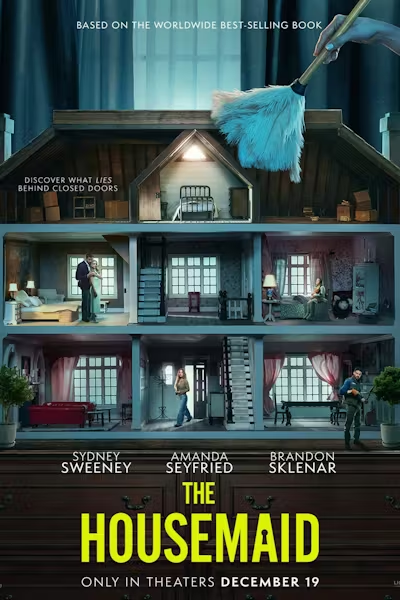
A trio of spellbinding performances anchors a sometimes successful new domestic thriller, Paul Feig’s The Housemaid (B-). The twisty film follows a young woman with a troubled past, played by a deadpan and eerily relatable Sydney Sweeney, hired as the live-in help for a wealthy family, the delightfully cuckoo Amanda Seyfried and smoldering hubbie Brandon Sklenar. Their seemingly idyllic life unravels when it becomes quickly clear the household hides some scandalous Stepford-level secrets. Rebecca Sonnenshine’s screenplay based on the 2022 Freida McFadden novel popularized on BookTok mostly delivers on the delicious conceits of the three-hander, although it pushed toward a hopeful level of campiness not fully realized. Both women are glorious in their equally emotional and physical roles, and Sklenar proves a powerful screen presence in his scenes opposite each. The movie is not overly scary or suspenseful and takes its time introducing grislier themes. It works best when snarkiness or sexiness rise to the occasion. The film’s crafts are top-notch with Naomi Munro’s posh production design and John Schwartzman’s cinematography providing a bountiful take on a garishly hypnotic and vaguely Hitchcokian suburbia. The film should have been more judiciously edited but is largely the kind of fun throwaway thriller we don’t get enough of at the movies these days.
Eva Victor announces her arrival on the independent cinema scene as sardonic writer, star and director of the tragicomic Sundance sensation Sorry, Baby (B+); and her raw, fragmented plot structure makes for a sneakily emotional knockout of an experience, set in and around New England academia. Given much of the narrative covers heavy subject matter, Victor wisely frames the film and starts it as a friendship story opposite the magnificent Naomi Ackie, with Victor’s grad student character’s signature wit and idiosyncratic outlook remaining center stage throughout, even during dark passages. The interplay between these two is hilarious and healing. The nonlinear story takes viewers through the protagonist’s variety of memories both playful and painful and sometimes overtly ordinary. It doesn’t depict the sexual assault that forever changed her life: in fact, it’s the clever scrambling of events that makes the film’s emotional and physical violations so potent and powerful. Victor’s unflinching near-soliloquy about the story’s inciting incident, tucked tenderly in a middle passage, is one of the best sequences captured on film this year. Reliable trauma film fixture Lucas Hedges and an adorable gray tabby kitten (not to worry, the feline survives) are enjoyable in small emotional support roles. It’s ultimately an uplifting and moving film about caring for one another from a perspective of someone who tells it like it is. Via these “Victorious” authorial hands, this movie is an apt exploration of how every day can be so much better than our worst day.
A peculiar mix of existential road trip journey and deeply human dystopian drama, this year’s international film contender from Spain is a curiosity made more memorable through the trance of its soundscape. Oliver Laxe’s transfixing drama Sirat (B-) is a puzzling tale set in Morocco rave culture and follows desert denizens through a series of raw, uncompromising and disturbing episodes. The main throughline is a quest for a missing girl, but a variety of congregating characters contribute to a narrative about people facing their limits. The ensemble of actors plays its respective parts with no clear standout (Nashville it ain’t), but Kangding Ray (aka David Letellier) is the film’s MVP providing the atmospheric electronic score. The movie’s high points are visceral, experimental and observant as it plays witness to earth’s people as playthings and random occurrences as part of cosmic universal truths. The film nearly begs for concessions served in a dime bag. Like many who may imbibe and watch this, it loses significant steam toward the end.
A luxury nine-screen cinema — introducing a next-generation moviegoing experience to the region — is beginning shows this weekend in a haven known for moviemaking and a creative environment nourishing storytelling.
The newest outpost of Southeastern chain Georgia Theatre Company, Inc. (“GTC Cinemas”) is opening at the region’s newest state-of-the-art entertainment and special event venue Trilith LIVE, located at 165 Trilith Parkway in Fayetteville, Georgia.
The new multiplex of auditoriums range from the GTX Georgia Theatre Extreme room which currently houses the Avatar sequel to smaller viewing rooms for independent or artier fare.
The new Georgia Theatre Company cinema promises a moviegoing experience unlike any other. It will feature a revolutionary Samsung Onyx screen for crystal-clear LED brilliance and the GTX Premium Large Format auditorium for an immersive audio-visual experience.
Complete with full-service bars, the theater is positioned to become a premier destination for unforgettable nights out. Businesses or groups can also reserve auditoriums for events.
“We are thrilled to partner with Trilith to introduce a cinema experience that sets a new standard for moviegoers,” said Bo Chambliss, president of Georgia Theatre Company. “We are not just opening a new theatre; we are creating an unparalleled entertainment destination. This cinema is a testament to our commitment to delivering the magic of the movies, and we can’t wait for the community to experience it with us.”
Among the many features of the new theatre are “Bargain Tuesdays” with discounted tickets. With all the talk about the relevance of movie theatres for shared experiences and a 2026 ahead with new tentpole Steven Spielberg and Christopher Nolan movies and new Shrek, Toy Story and Avengers blockbusters, it will be a watershed year for major event spectacles.
We’ll share more news as our Silver Screen Capture team pays its first visit to Trilith Cinemas for Friday, December 18 programming.
Get to KnowTrilith LIVE!
Trilith LIVE, the region’s newest state-of-the-art entertainment and special event venue recently announced its grand opening season of live events, set to ignite Fayetteville with a vibrant slate of concerts, family shows, corporate meetings and community events. The grand opening season gets fully underway in 2026 with a variety of entertainment events.
This multi-faceted development promises to transform the region’s cultural landscape, offering an unparalleled array of live performances, cinematic experiences and unique events. The project has attracted a dynamic mix of touring artists, television productions, corporate meetings and conventions that will strengthen Fayette County, Georgia’s position as a hub for economic development. Many have already been enjoying live game shows and reality shows in the venue’s live sound stages.
“Trilith LIVE is more than just a venue; it’s a new epicenter for arts, culture and entertainment in the region,” said Matt McClain, executive director & general manager of Trilith LIVE. “We’ve built a space with state-of-the-art technology and incredible flexibility to attract a diverse lineup of live entertainment and special events. We are incredibly excited to open our doors and provide unforgettable experiences for this community and beyond.”
Engineered for adaptability, the venue features an immersive sound system, massive LED walls and a full broadcast suite. With a capacity of up to 2,800, it will host everything from major concerts and performing arts to corporate events and banquets.
Trilith LIVE’s inaugural live entertainment season has a lineup that caters to all audiences, including the following events announced so far:
Gabby’s Dollhouse Live! – Jan. 15, 2026
Jackie Hill Perry – Feb. 7, 2026 (sold out)
38 Special – Feb. 13, 2026
An Evening with October London & Lalah Hathaway – Feb. 14, 2026
Popovich Comedy Pet Theatre – Feb. 17, 2026
Dwight Yoakam – Feb. 20, 2026
Hairball – Feb. 27, 2026
Rick Braun – Feb. 28, 2026
Home Free – Highways & High Seas Tour, March 20, 2026
Little River Band – March 28, 2026
Legends of Laughter: Sommore, Earthquake, Lavell Crawford and Don DC Curry – April 11, 2026
Michael W. Smith – April 18, 2026
Handyman HalComes to Town – April 24, 2026
Jeffrey Osborne – May 2, 2026
Randy Travis – The More Life Tour with guest vocalist James Dupre’ – May 22, 2026
Trilith LIVE’s corporate gatherings and community events include the following events announced so far:
Etherio Company Meeting – Dec. 15, 2025
City of Fayetteville CPR Training – Dec. 17, 2025
Fayette County Development Authority Meeting – Jan. 20, 2026
Fayette County Intergovernmental Business Outlook – Feb. 12, 2026
CREW Leadership Summit – Feb. 26, 2026
Georgia Chamber of Commerce Conference – March 11, 2026
Fayette County Board of Realtors Awards Gala – March 21, 2026
Fayette PRC Spring Gala – March 27, 2026
Harp’s Crossing Christian Academy Annual Fundraising Gala – April 30, 2026
Faith & Institutional Investing Summit – June 4-5, 2026
Hitachi Construction Machinery Americas Conference – July 21-23, 2026
State of the Industry hosted by Trilith Studios – Oct. 22, 2026
Two Sparrows Village Bird Bash – Nov. 13, 2026
For more information about these events at Trilith LIVE, please visit the facility’s website.
Passion City Church at Trilith LIVE
Adding to the community’s vibrant spirit, Passion City Church will soon make Trilith LIVE its newest location. Known for its mission centered on the glory of God, radical grace and extravagant worship, the church will bring its message to Trilith LIVE to further enrich the diverse fabric of Trilith and underscore the development’s commitment to fostering connection and shared experiences.
“Passion City Church is thrilled to make Trilith LIVE our home—a place to gather as followers of Jesus, build strong community, and host city-wide events,” said Louie Giglio, global pastor of Passion City Church. “It will take all of us, through collective generosity, to bring this vision to life and create a space where we worship.”
For more information about Passion City Church, please visit its website.
About The Town of Trilith
The Town of Trilith, adjacent to Trilith Studios, is a 235-acre master-planned residential and mixed-use project in south metro Atlanta. Envisioned as a gathering place for creatives, artists, storytellers and makers, this European-inspired community will include 750 single-family homes, 600 multifamily lofts, 300 hotel rooms and 270,000 square feet of restaurants, retail, office, and commercial space. The residential neighborhoods at Trilith comprise the largest geothermal community in the United States, with 51% of the development dedicated to green space that is currently home to more than 1,000 trees. Upon completion, residents will have access to 15 miles of nature trails, 54 acres of forest, 19 landscaped parks, and one of the most sophisticated and welcoming dog parks in the world. For more information about Town of Trilith, please visit its website.
Kleber Mendonca Filho’s The Secret Agent (B+) is a B-movie with a purpose. Even its title is a disguise for what it actually is. The movie follows a former professor played by a towering Wagner Moura who is caught in the political turmoil of the final years of the Brazilian military dictatorship, attempting to flee persecution and resist an authoritarian deceitful regime. Time jumps, all-out action scenes, even fantastical sequences punctuate a ‘70s stone-cold simmer. Leveraging the conventions of a pulp picture or drive-in style film helps some of the director’s headier themes rise to the surface. Moura is a charismatic and expressionistic vessel for the director’s intentions. It’s an engrossing film with carefree detours and hot takes on the way to profundity.
In a year with legitimate soaring music in a film set in the music industry (the rap face-off plus the pop songstress finale in Highest 2 Lowest) and moving film-within-a-film (the virtuoso director character in Sentimental Value lensing truly moving footage), Director Bradley Cooper’s Is This Thing On? (C) manages to make stand-up comedy look about as boring as could be. Will Arnett’s protagonist is down in the dumps as his marriage to Laura Dern’s character crumbles, and he takes on open mics as a form of therapy. The cinematography gives a “you are there” quality despite it not being clear why any of us are there. The best sequences in the film are opposite child actors (they’re great). The film is neither funny nor insightful enough to stand out as either root word of “dramedy.” Arnett and Dern embody authenticity as real people, but they’re forced into scenarios and situations that don’t feel incredibly thought out. No star is born here nor any act of a maestro is on display. This one feels a little like they’re making it up as they go along.
You can call it playing a character “similar to himself” all you want, but George Clooney isn’t stretching all that much as a veteran actor regretting some of his choices in Noah Baumbach’s Jay Kelly (C). To flee an incident likely to get him bad press, the protagonist and his longtime manager (Adam Sandler) step away to Europe, where there’s reflection on his legacy, a look back at his cinematic canon and a flurry of memories about choices he made related to his daughters (Riley Keough and Grace Edwards). Baumbach fills the film with insider elements about the movie business but fails to paint an intriguing central character. With not much interesting to see related to the titular character and the sidelining of an inciting incident, Sandler gets a few moments to shine as he laments whether he’s a friend or a cost center in a few sequences opposite Laura Dern as a similarly underappreciated publicist. This meta narrative treads very little new themes and isn’t particularly insightful or funny. There’s a moment during a film retrospective that was kind of embarrassing in its awards season thirst. This year alone, the film Sentimental Valueis a far richer film on the gulf and intersections between art and humanity.
Writer/director Jafar Panahi’s It Was Just an Accident (A-) traces a chance encounter at a body shop between two men in modern Iran who may or may not share fraught history; and as other characters enter the fray too, memories of the background between the two primary men become even more blurry. This is like a heist movie without the bounty: as the band gets together, the pieces of a political puzzle coalesce. Vahid Mobasseri is the standout main character, and viewers get to watch his vacillation over remembrances and feel his penchant for vengeance against an oppressor. Expect vigorous debates and revelations and sparse use of artifice like musical score. Panahi, who has risked his life and liberty for his anti-regime filmmaking, gets a stellar auteur showcase with this movie. It comes together beautifully in the final passages and is sure to spark discussion.