Summer finally has a superhero. Using interviews and rare archival footage, Dawn Porter’s documentary John Lewis: Good Trouble (B+) traces the titular congressman’s 60-plus years of social activism and legislative action on issues ranging from civil and voting rights to healthcare and immigration reform. It’s a delight to watch the political and protest survivor witness and reflect on historical reels which feel as urgent as ever in today’s climate. The film successfully criss-crosses from modern day to moments in history, drawing rich parallels. Particularly poignant are sequences of lunch counter sit-ins and of the legendary Freedom Rides as the young gamechanger asserts his rights and showcases his resolve. Even the setbacks presented strengthen his might. What starts as a contemplative chronicle becomes a sensational summons for action.
Update from June 2020 review: The civil rights icon and longtime congressman passed away after a six-month battle with cancer on July 18, 2020. You can also explore more about John Lewis in the film Selma.
Will the winner take it all or the loser stand small in the summer’s new cult comedy? David Dobkin’s featherweight and overlong Eurovision (B-) stars Will Ferrell and Rachel McAdams as an earnest Icelandic pop music duo in a quixotic quest for the coveted championship in the iconic global song contest. Much of the film is formulaic with slogs which threaten to derail its kitschiest instincts. Ferrell, who also co-wrote the film, is basically funny just for showing up with long hair and a European accent, but the plucky McAdams is really the heart of the proceedings giving a lively and sensitive star turn. Dan Stevens is also enjoyable as a charismatic competitor in rhythm and romance, and Pierce Brosnan gets a nice bit as Ferrell’s fisherman father. The film’s stealth signature turns out to be its garish production numbers and surprisingly hummable original songs including “Volcano Man” and “Double Trouble.” There’s also a mega mix midway that helps perk things up just when the screenplay of the American idylls. It’s easy to forget moments that misfire when the overall tone is so blissful.
Sometimes DIY extends to people, and this latest twist on the Jerry Maguire archetype doesn’t give its prickly prince too far to rise to get out of his rut and assume his comic crown. Judd Apatow’s dramedy The King of Staten Island (B-) is a splendid showcase for slacker comedian Pete Davidson, who plays a 24-year-old stoner tattoo artist doing little with his life while cohabitating with his widowed mother (Marisa Tomei). The millennial protagonist’s world is upended when mom gets a new boyfriend (Bill Burr), which leads to a steady climb toward clarity and consciousness. Despite Apatow’s leisurely pace and uncertain tone, Davidson shines in the role of a character ascending to independence, with a sometimes sarcastic and occasionally soulful perspective. His wide eyes, stick figure physique and zany body art make him a perfect “rejuvenile” in search of a raison d’être. Tomei is also a delight with humor to match her obtuse offspring, but Burr is kind of a nothing-burger of a character as the newfound father figure. The function of surrogate dad as a way to stimulate the film’s man-child into a new awakening is less interesting than Davidson’s sequences bantering with pothead friends, his misanthropic exploits in odd jobs and his witty interactions with kids who are largely alien to him. There are dollops of wry jokes and fun pranks, but much of the film feels like it’s on an anti-depressant with few peaks and valleys. Still, the film has heart and is often quite amusing. Prepare for another inexplicably protracted Apatow running time, and just enjoy Davidson’s sprawling new rise to reels of royalty.
Hollywood has a history of journeying down Vietnam’s rivers and through its jungles to heal the heartbreak shrouded in the ruins of war. Spike Lee’s Da 5 Bloods (B) starts innocently enough with a quartet of affable modern-day African-American veterans reuniting in a Ho Chi Minh City hotel to embark on a search for the buried bones and bullion left behind by a fallen platoon leader, played in flashbacks by Chadwick Boseman. This memory film’s twisty heist plot is also a bit of a Western, as in a commentary on Western Civilization, always urgent even if occasionally overreaching or delving into myriad detours of flourish. Delroy Lindo gives a forceful, hot-headed performance as the primary old timer, the MAGA hat wearing Paul, who like his comrades, also plays himself at an earlier age without the magic of de-aging special effects. Lindo gives an astonishing muttering monologue after a critical series of action sequences that’s career best. He’s like a land mine one step away from self-actualization, and he’s fascinating to watch in his masterclass of acting. Lee’s crisscrossing techniques through history gracefully bridge past transgressions to a tableaux of modern topics ranging from imperialism to contemporary class and racial politics. The movie comes most alive in its celebrations of brotherhood and fatherhood; Jonathan Majors is memorable and moving as Paul’s estranged college son. Terence Blanchard’s music is stirring accompaniment to action and ache, with occasional soothing echoes of Marvin Gaye. After his brilliant BlacKKKlansman, Lee’s follow-up is a bit more narratively sprawling but thematically daring. The thoughtful director’s change of venue from American soil enables no less a promised land of issues to travel and unravel.
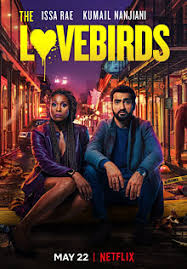
Issa Rae and Kumail Nanjiani have such spectacular comic and romantic chemistry as the central couple in Michael Showalter’s The Lovebirds (B-) that they deserve a better movie next time they collaborate. It’s clear even in the cold open introductory credits that this brilliant duo possesses charisma in spades with hilarious banter and priceless reactions. The plot is super obligatory as the twosome is unintentionally embroiled in a murder mystery. As their quest to clear their names takes them from one extreme circumstance to the next, they must figure out how they, and their relationship, can survive the night. Along the way, they crib from diverse sources ranging from Wayne’s World to Eyes Wide Shut with reckless abandon. Each preposterous sequence is improved by Rae and Nanjiani’s daft delivery. It’s a breezy fun time, a comedy/action confection with modest levels of sophistication hiding in the routine madness. This comic couple is definitely one to watch.
A new HBO film throws the book at a public school scandal but takes a little while to get to its thesis. Cory Finley’s Bad Education (B-) tells the true 2002 story of a corrupt Long Island village school superintendent responsible for the sector’s largest embezzlement in U.S. history. In this central role, Hugh Jackman plays against type: an exquisitely controlled performance of a vain, dark and diabolical heart. Viewers are left wanting more insight into what drives this man, additional details about his relationship with his financial enabler (played with relish by Allison Janney in an all too brief role) and any contours about what drives a teenage journalist protagonist (impenetrable performance by Geraldine Viswanathan) who unearths the malfeasance. Finley’s compositions of bureaucratic bungling and many droll line readings are delightful, as is the jolting, percussive score by Michael Abels. But if there were an open-ended essay pop quiz every few minutes about what makes this film more distinctive than others in the genre, creative answers would be difficult to conjure. It’s an engrossing and watchable drama nonetheless, worth watching for Jackman’s performance alone. It’s now available on HBO streaming services.
Behind the anti-gay military policy resulting in the dismissal of lesbian army hero Colonel Margarethe Cammermeyer (famously portrayed by Glenn Close in the 1995 movie Serving in Silence), a clandestine couple — a veritable female Rosencrantz and Guildenstern in a real-life saga – provides the fascinating side story that propels its way to center stage in a pivotal moment in history. Documentarian Cindy L. Abel’s sophomore feature film Surviving the Silence (B+) unearths the narrative of Colonel Patsy Thompson, a woman from the rural south who becomes a beloved nurse in the military, harbors a closeted love in the form of life partner Barbara Brass and finds herself presiding over the board in the critical “Don’t Ask, Don’t Tell” case against Cammermeyer. As the film’s central subject, Thompson is a plucky protagonist who comes out late in life but consistently summons the fortitude to live with dignity amidst the various challenges confronting her. The high profile of the tense tribunal forces her to confront her own story in a journey to live out loud. Abel and her documentary team weave together this uncanny tale using archival footage, home movies and images, interviews and even animation to bring the powerful stories of these trailblazing women to the forefront. The film does a splendid job taking viewers inside the inspiring love story of Thompson and Brass, from their furtive first date to their use of secret codes to communicate during a stint at the Pentagon, which makes the film’s denouement all the more poignant. Denise Gentilini provides stirring music, especially her end-credits song. The film showcases accidental activists simply trying to live their truths. It’s a timely testament to women in love rising to the occasion of destiny.
The first year of college can feel like you’re on the verge of something amazing or the brink of tears, and for the homesick protagonist of the breakout 2020 South by Southwest film Shithouse (aka Freshman Year) (A-), it’s a vulnerable journey from mope to hope. Cooper Raif is writer, director and star of this DIY gem of a film with lived-in performances, droll dialogue and a generally appealing scrappiness portending a star being born. Dylan Gelula is excellent as the resident advisor and potential romantic partner who beguiles the confused frosh, and Logan Miller is the unreliable roommate who first tells our hero about the irreverent titular party headquarters where destinies could take a turn. There are undercurrents ofBefore Sunrise here in the talky travelogue of campus life but with characters who are sending very mixed signals. Raif is funny and fresh and doesn’t mind wearing his emotions on his sleeve and gives a great speech about those in a relationship at least needing to be on the same team. There are many creative conceits involving an encouraging childhood plush toy who communicates in subtitles, a wake for a reptile and a botched sex scene filmed as awkwardly as its confusing content. This is one of those movies the viewer simply chills with as opposed to being bombarded with constant jokes, and the hang is definitely worth it.
This is one of the great romances. Writer/director Céline Sciamma’s Portrait of a Lady on Fire (Portrait de la jeune fille en feu) (A+) is a French historical drama tracing the contours and the canvas of an enduring love. Set in France in the late 18th century, this masterwork obeys the conventions of period romances with its windswept coast and Gothic homestead but upends the typical narrative rules in tracing a truly scorching and revolutionary tale. Noémie Merlant plays the commissioned painter and Adèle Haenel her aristocratic subject, and both actresses are spellbinding in their passion for detail and commitment to superb tandem acting. Merlant’s character is told her subject is unwilling to be sketched and thus must be painted in secret, and thus begins an observation period with flourishes of the forbidden. Sciamma creates indelible characters in a ravishing work and weaves an intoxicating chronicle. This feisty and fiercely feminist film rewards those who are patient for character studies and relish movies with the heart of a classic text. This is one of the great sleeper films of 2019 and one adventurous cinema lovers should seek out and see.
This is the movie for the “no labels” generation. Keith Behrman’s Giant Little Ones (B+) eschews many typical coming of age conventions to chronicle a few weeks in the life of a teenage protagonist (Josh Wiggins, a thoughtful performer and dead ringer for a young Matt Damon) caught between a variety of impulses in the aftermath of a frisky birthday party. Marquee stars Maria Bello and Kyle MacLachlan are outstanding in supporting roles as the hero’s estranged parents in this contemplative Canadian production with lots of questions and few answers tied in easy bows. Darren Mann as the stoic swim team captain, Taylor Hickson as his distant sister and Niamh Wilson as a lovely female friend who may or may not be transgender are among the compelling characters whose story arcs don’t always travel in obvious directions. A brisk story and surprisingly tender dialogue give this drama additional distinction. It’s a sleeper film worth discovering buoyed by relatable characters and an optimistic outlook.
Times of quarantine can benefit from a little elf help, as a major animated theatrical release careens quickly to the home screen with video-on-demand and Disney+ providing a safe social distanced landing. Dan Scanlon’s Onward (B-) is mid-tier Pixar, no doubt, filled with fanciful frames of kid-friendly highjinks before culminating in the emotional payoffs adults will dig. The medieval pixels are summoned for brotherly buddy comedy as two elf siblings in an alternate modern suburbia filled with formerly magical and mythological characters invoke an ancient spell and embark on a quest to bring back their deceased father for just one day. The story and script are a bit bland, the character renderings and landscapes a touch unappealing and the adventure pedestrian at best, but then every once in a while there’s magic in this gathering. A charming dance moment and a heartfelt hug just may touch the heart and tickle the tear ducts. Tom Holland and Chris Pratt perform the two main voice roles, and what they lack in interesting things to say is often eclipsed by solid enthusiasm. The half-dad effect, the elves themselves and a dragon-infused denouement all fail to impress, but even a sometimes lackluster lark can pass muster and time in a moment of uncertainty.
The audacity of a far-fetched plot in the latest remake of The Invisible Man (B) all but vanishes under the steady direction of Leigh Whannell and spellbinding central performance of Elisabeth Moss. The H.G. Wells story and classic films have been modernized with a strong woman at the center and a streamlined narrative about recovering from manipulation and abuse. Aldis Hodge is also fantastic as the heroine’s policeman friend; and while his role is somewhat “transparent,” Oliver Jackson-Cohen makes an impression in the title role, a controlling husband and Silicon Valley magnate who has invented an optical illusion suit allowing him to be fully invisible. The film is more thriller than horror film, despite the sense of dread in its first half. The stunts and visual effects are pretty nifty, and Benjamin Wallfisch’s score is sufficiently macabre, with ostinati aplenty. The film was a little too much like 1991’s Sleeping with the Enemy at times, but the twists and turns dialed up the novelty. Moss, who is seen in virtually every scene, delivers richly here and makes the entire enterprise fresh and believable. It’s nice to see popular entertainment with a smidgen of topicality so wonderfully packaged.