

 The haunted house movie, the expectant mom horror film, the pretentious self-aware arthouse offering and the annual fall travesty starring Jennifer Lawrence all sink to incredible new lows in the gobsmackingly bad new Darren Aronofsky film, Mother! (D). Rarely has a ham-fisted metaphor been more startlingly stretched over a motion picture’s running time. Ostensibly this often irritating film is about an author (Javier Bardem) and his wife (Lawrence), both written as extraordinarily passive, as they rebuild a secluded Victorian mansion and their life together after a tragic fire and try to stave off a series of invasions into their space. The preposterous and inexplicable events that occur as the story unfolds are simply stupefying and increasingly shrill. What starts with genuine menace and some real scares devolves quickly, and the payoff should really involve a refund. From the bizarre lack of chemistry between Lawrence and Bardem to unusual cameos involving two additional Oscar nominees, a former member of the SNL ensemble and a Force Awakens cast member, this cavalcade of hot mess surprises at every corner and not in a good way. Finding out some of the illusions are actually allusions provides only a modicum of solace after all the cacophony. The story and subplots are at the mercy of the symbolism, which renders character intention irrelevant. I did like Michelle Pfeiffer, who makes some fun and arch choices with her houseguest-from-hell character. Ultimately Aronofsky’s off-putting opus plumbs more biblical proportions than even his misbegotten Noah. By the end, the experiment was obvious, and it was performed on the audience. See this film only to discuss it.
Tag Archives: Horror

“It” (2017) is Ho-Hum Stephen King Horror Adaptation
 Being trapped in a funhouse of fears with precocious kids and a flesh-eating dancing clown may be the stuff of horror film aficionado fever dreams. But something is definitely missing in Andy Muschietti’s movie adaptation of Stephen King’s novel, It (C+), chapter one of a planned duology, a film that oozes with Spielbergian nostalgia but mostly floats in a preposterous purgatory. The director starts with promise and establishes a credible hero played by Jaeden Wesley Lieberher. The youngster leads a tepid tween team of protagonists who are a bit too Stand By Me-esque to feel like true originals. The first glimpse of Bill Skarsgård as the phantom pantaloon with a Cockney cannibal pie hole is menacing indeed. But too many kids, too many CGI shape-shifters and too many similar set-ups render the enterprise less than terrifying. After a while the answer to everything seems to be, “Cue the clown!” It’s ultimately a horror film without enough scares. Sophia Lillis is a standout as a young lady battling family dysfunction, but hers and all subplots are half-baked. These goonies aren’t good enough. By the end, it’s rather unclear why things unspool the way they do or why it might take a second chapter to tell this tale.

“It Comes at Night” is Suspenseful
 Written and directed by Terrence Malick protégé Trey Edward Shults, It Comes at Night (B+) is a superb psychological horror film that wrings generous art house thrills out of a straightforward apocalyptic premise. A couple and their son (Joel Edgerton, Carmen Ejogo and Kelvin Harrison, Jr.) have secluded themselves in a country home as a contagious disease plagues the outside world, and they are faced with a cat and mouse dilemma when visited by another couple and their son (Christopher Abbott, Riley Keough and Griffin Robert Faulkner) who may or may not be safe or worth harboring. Edgerton and Abbott are fabulous foils, one the rule-abiding master of an elaborate isolated house and the other the scallywag with a backstory. The casting is creative and unexpected: Abbott is wonderful, and the acting is great all around. Shults makes the most of a fairly low-budget bare-bones production space to stage his wicked one-upmanship. He is imaginative in what he doesn’t show the audience and teases with darkness as an effective canvas for scares in the first act before introducing a more conventional narrative. Hardcore horror fans may be let down by the lack of gore and by the calculated pace, but this summer film-goer was delighted at the effective storytelling on display.

Jordan Peele’s “Get Out” is a Powderkeg of a Psychological Thriller
 Prepare your senses for the clock-woke orange pulp confection of audacious moviemaking to hit a nerve in some time. Funnyman-turned-first-time-director Jordan Peele’s psychological thriller Get Out (A-) is a suspenseful and lively tale of a twentysomething black photographer (Daniel Kaluuya) visiting the suburban family of his white girlfriend (Allison Williams), and the maiden voyage is a mindbender. Let’s just say that after the home tour, the events that follow will leave you guessing about a whole lot more than who’s coming to dinner. From the spot-on casting of Williams’ ultra-progressive parents to the sustained sense of dread around the townspeople and groundskeepers, Peele depicts the mounting terror that may be afoot in the neighborly facade. It’s like Shining-era Stanley Kubrick got an all-out David Lynching. Themes about the appropriation of race and culture are seamlessly marinated into a savory stew of a storyline; and the acting, music, sounds and setting all work in harmony to incredible effect. Catherine Keener is a standout as a therapist with unconventional hypnotic techniques, brilliantly rendered. As a horror film, it’s less gory and more allegory. But it’s edge of your seat material and sure to be the conversation starter of the year!

“Split” is a Very Watchable Psychological Thriller
 Regaining his strut as a writer/director of modern-day suspense films, M. Night Shyamalan has crafted an entertaining psychological thriller and met an acting match for his cinematic chutzpah in James McAvoy headlining Split (B+). The film is above all else a showcase for the considerable acting talents of McAvoy as a man with 23 discrete personalities (Dennis, Patricia, Barry and Hedwig among the most notable). McAvoy uses some pretty sly ticks and tricks to bring brilliant life to his menagerie of characters. What starts as an abduction and escape room type movie in the vein of the recent 10 Cloverfield Lane becomes a more labyrinthine glimpse into a shattered mind. The female protagonist played by Anya Taylor-Joy helps anchor the film gracefully; she’s a perceptive outsider bent on cracking the code of the man holding her captive with two other teens. It’s also a hoot to see a late-career Betty Buckley in fine form clearly relishing a role as a therapist specializing in split personality disorders. The two other abducted teens played by Haley Lu Richardson and Jessica Sula aren’t quite as indelible in the face of other sharp characterizations. The film is mesmerizing at times and taut throughout until the end, when it limps a bit to the finish line. Like his clear antecedent auteurs Hitchcock and De Palma, Shyamalan has created a twisty tale full of engaging mental machinations. It lacks the visual urgency to match its lead performances and can’t quite sustain the mental sharpness of its moving pieces. But for horror fans who like a PG-13 level basket of scares, it’s a gangbusters gateway drug to the genre and a corker of a story.

“JeruZalem” is a Holy Terror
 Yoav and Doran Paz’s JeruZalem (B) is a welcome addition to the found-footage horror genre, with a compelling female-centric viewpoint, a mysterious setting and a surprising portal for storytelling. Two traveling American females winningly played by Yael Grobglas and Danielle Hadelyn meet a young anthropologist, the charming Yon Tumarkin, on a plane to Israel and divert from Tel Aviv to Jerusalem for what becomes a vacation to the gates of hell. In addition to the novelty of on-location shooting in the Holy City, the film’s revelation is that it’s seen through the eyes of a Google Glass type application. Facial recognition, virtual reality avatars, photo freeze-framing and links to popular social networking sites rendered right in front of Hadelyn’s character’s line of sight add a compelling mind’s eye viewpoint into proceedings both commonplace and apocalyptic. Tom Graziani is also a delight as the Arabic host who turns the travelers on to hostels, hummus and hash before the quartet all face horror together. A sinister and sly story for the selfie age, the film suffers a bit when it veers too sharply into the conventions of its genre, and there are missed opportunities to plumb some of the film’s potential religious ramifications; but high production values and a smart POV ultimately win the doomsday.

“The Babadook” is Scary
 Writer/director Jennifer Kent’s The Babadook (B) is a highly suspenseful Australian-Canadian psychological horror film focused on Essie Davis in a terrific performance as a grieving single mom and superb child actor Noah Wiseman as her disturbed boy. When they discover a children’s book about a maniacal madman who is trying to infiltrate their home, the mother and son must summon all in their power to preserve whatever sanity is left in their domestic life. Music and sound effects augment this classic tale of home and hero possession, and it almost fully delivers on the promise of its premise. It’s creepy, deeply relatable and a great example of how time-honored horror tools and solid acting can pack a paranoid punch.

“Cabin in the Woods” (2012) an Inventive Horror Film
 Director Drew Goddard’s film of a story he co-wrote with Joss Whedon, Cabin in the Woods (B+) is a funny and subversive deconstruction of the horror genre with shocks and surprises to delight terror flick enthusiasts and virgins alike. From the opening frames, it’s clear this is a bit of an upstairs/downstairs tale with parallel dimensions to the story. It’s quite a cozy conundrum.

Lars von Trier Directs Disturbing “Antichrist” (2009)
 Lars von Trier’s Antichrist (C-) is a well acted and supremely disturbing art house horror film ostensibly about the grieving process by a couple for their deceased child and ultimately a bizarre requiem summoning imagery from the Biblical fall from grace at Eden through the mistreatment of women in Salem. Some of the metaphors and mystery are spellbinding and others less revelatory than Trier may have intended. Despite conjuring fearless performances by Willem Dafoe and Charlotte Gainesbourg and maintaining an eerie slow burn of mounting imagery of dread and isolation, the iconoclast filmmaker can’t get out if his own way to make sense of muddled themes and mixed messages. The NC-17 rated film is full of graphic imagery and is not for the faint of heart.

M. Night Shyamalan Makes Mighty Mark with “Sixth Sense”
 M. Night Shyamalan’s supernatural thriller The Sixth Sense (A-) pairs Bruce Willis and child actor Haley Joel Osment for a tender and suspenseful look at the afterlife. As a psychologist helping a boy who believes he sees and talks to people who have died, Willis is absorbing and effective. Newcomer Osment is very good in his role. Shyamalan turns the screws with great suspense, leading to a stunning showdown with fate.

“I Know What You Did Last Summer” and I’m Not That Impressed

Jim Gillespie’s I Know What You Did Last Summer (C) is an average entry into the horror renaissance ushered in by Scream. Producers realized they could churn out movies on the cheap with attractive young casts, and this is no exception. Jennifer Love Hewitt, Ryan Phillipe, Sarah Michelle Gellar and Freddie Prinze Jr. play friends who are being stalked by a killer, one year after covering up a car accident in which they were involved. The film never catches fire despite some suspenseful moments. It’s imminently watchable and immediately forgettable but gave birth to a few stars who have done steady work since.

“Scream 2” Provides Many Meta Thrills
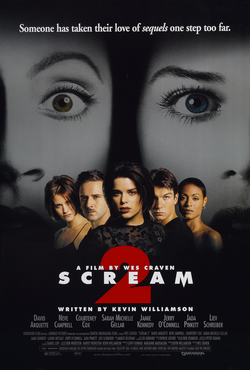 Wes Craven’s Scream 2 (B-) tries to one-up its tongue-in-cheek predecessor by satirizing sequels, often with great success. But the film-within-a-film and the story-within-a-story conceits may sometimes make this a little too meta for its own good. Still it is twisty, thrilling and united the original cast with enough surprises that it stands on its own with more of the brand of fun fans of the franchise will come to expect.