I've reviewed films for more than 35 years. Current movie reviews of new theatrical releases and streaming films are added weekly to the Silver Screen Capture movie news site. Many capsule critiques originally appeared in expanded form in my syndicated Lights Camera Reaction column.
Benedict Cumberbatch casts one helluva spell as an intellectual, cerebral superhero with the ability to shape-shift his surroundings in Scott Derrickson’s Doctor Strange (B), a mostly engaging entry into the Marvel multiverse. The title character is an arrogant surgeon who gets his comeuppance in a crushing car accident and subsequently turns to mystical arts in an effort to heal. Cumberbatch is an unlikely protagonist, but he’s witty, literate and believable in a world in which the supernatural stakes mount mightily. Like Tony Stark/Ironman, his smarminess and smarts with science help his journey take flight. Derrickson cribs from Christopher Nolan a bit too much with secret societies of Asian warriors and Inception style city bending, but the overall vibe is cunning and imaginative. If anything the pace could have been picked up in Kundun style monastery sequences. The effects of hopping out of one’s body make for some giddy multitasking fight sequences, and the hero’s CGI cape should win best supporting costume. Tilda Swinton commands her every mesmerizing sequence as a trippy bald sorceress in a mustard-colored frock. Rachel McAdams and Chiwetel Ejiofor don’t get much to do as an ER doctor and fellow warrior, respectively; and Mads Mikkelsen is menacing as a baddie who looks like he just finished a bender at the discotheque. But it’s really the casting of the central role that’s the coup de grace of this time and space oddity.
An epic true tale of faith has met its match in a filmmaker for whom fire and brimstone are merely a prelude, and the power and singularity of his vision on screen cannot be denied. Director Mel Gibson’s Hacksaw Ridge (B) is a tough mudder of an action movie, hearkening to the actor-turned-director’s own roots in Peter Weir’s WWI classic Gallipoli and imprinted with a world-weary POV applied to WWII’s Battle of Okinawa. Funneled through Gibson’s prism of gore and glory, the film is far from subtle but nonetheless audaciously moving. At the center of the proceedings – and key to its believability – is Andrew Garfield’s knockout portrayal of real-life American hero Desmond Doss, whose Christian beliefs prompted him to become a conscientious objector to violence simultaneous to enlisting in the military as a medic without a gun. Opening sequences feel like a Whitman’s Sampler of giddy nostalgia that would give Forrest Gump a run for his money in treacly sweetness. But soon after dispensing with some basic training melodrama, the film quickly detours into a fog and slog of war and a series of difficult decisions and riffs on themes of sacrifice and redemption. The director is adroit at putting the viewer in the heart of the action, relating to the protagonist’s fear and faith of being disarmed in the face of encroaching force. Aside from casting Vince Vaughn against type as a droll drill sergeant, the filmmaker rounds out his ensemble with sterling British and Australian actors ranging from Sam Worthington to Hugo Weaving to a relative newcomer, the delightful Teresa Palmer. The images of war are among the most suspenseful and sensational committed to screen, with the titular ridge, flanked with a mountain-high netting leading infantry to setbacks and triumphs, among the splendid set pieces. The sheer duration of some of the sequences dull their impact, but the fight choreography is second to none. Many will love the film’s messages but be turned off by the graphic violence; others repelled by Gibson will miss out on a poignant story. The auteur has once again found the pulse of an incredible and inspiring brave heart.
Written and directed with poignancy and grace, Barry Jenkins’ Moonlight (A) is urgent in telling a three-chapter coming of age story of a young African-American man named Chiron and how his experiences growing up in America (largely in a surreal pastel drenched Miami) shape his identity. Rather than tackle only the physical violence associated with most inner-city dramas, the perceptive Jenkins traverses the emotional landscapes of self-worth, racial identity and sexuality and how Chiron learns to find traces of comfort in his own skin. The writer/director has fashioned a very dynamic narrative around a shy and withdrawn protagonist; as embodied by three supremely talented actors – Alex Hibbert (child), Ashton Sanders (teen) and Trevante Rhodes (young man), viewers will ache for him to come to answers. Naomie Harris is devastating as Chiron’s emotionally abusive addict mother, and Mahershala Ali is magnificent as a drug dealer who takes on a role as a near-spiritual guide. The film explores the games people play with each other and with themselves in their quest for acceptance. The clues aren’t easy to discover as the film employs an overall tone of heartache punctuated with bursts of uplift, but the journey is consistently gripping. Based on a play by Tarell Alvin McCraney, the film is splendid and assured cinema with an austere and stunning score by Nicholas Britell and a dreamlike color palette created by cinematographer James Laxton and colorist Alex Bickel (first chapter emulates Fuji film stock to emphasize skin tones followed by Afga film stock adding cyan and the final chapter in Kodak form). This is a must-see for cinephiles and is moving indeed as it pinpoints exactly why this Black life matters, expanding consciousness and empathy, and how the people who come into our lives shape our evolving selves.
Mick Jackson’s Denial (C) doesn’t do cinematic justice to a true-life tale of an American professor who has to defend herself in British courts for defaming a Holocaust denier. Rachel Weisz isn’t quite compelling enough, a serpentine Timothy Spall isn’t given adequate on-screen time and the court proceedings seem rather perfunctory. A trip to Auschwitz death camps provides some powerful context about history, forensics and the nature of truth. The story is a bit of a less literary Inherit the Wind with few surprising flourishes. With topics of this much gravitas, it just didn’t feel like the filmmakers’ passions were fully ignited.
Somewhere on the cinematic patriarchs continuum between Captain von Trapp and the Great Santini, Viggo Mortensen gives a sensitive, soulful and indelible portrayal of a flawed but well-meaning dad in Matt Ross’ incredibly engaging Captain Fantastic (A-). Mortensen is the draw here, summoning a rugged loner charisma that at this point can just be called “Mortensenesque” as a man raising his six children off the grid in the mountains of the Pacific Northwest with unconventional techniques to teach them self-sufficiency, critical thinking, peak physical performance and a global worldview. His headstrong homeschooling, an ongoing ropes course and debate society in the woods, wins him no favor with his in-laws (well played by Frank Langella and Ann Dowd) but makes him a hero in the eyes of his neo-hippie children, all beautifully played. George MacKay is an earnest delight as the oldest of the offspring, incredibly moving as he experiences a date for the first time after being shrouded in the wilderness. Ross makes an assured directorial and writing debut, showcasing the central family’s confrontations with society in a way that keeps you guessing of whether or not it will all work out. There was a melancholy moment I thought would be a pensive ending, but I liked the extended epilogue – including an unforgettable family jam session – even more. The film is a cult sensation challenging American mores in the tradition of Easy Rider and Into the Wild and highly recommended.
Usually the mere thought of a new entry into the mockumentary series pioneered by writer/director Christopher Guest brings a sly smile to the face. Alas the funny auteur’s Mascots (D+), a direct-to-Netflix take on furries who get fans in a frenzy, doesn’t get animated nearly enough. Perhaps after exploring theatre, dog shows, movie awards and folk music, the format is getting stale. The overall ensemble lacks energy, and the story has a paucity of punch. The lack of central protagonists or and major plot momentum lead to a ho-hum competition devoid of drama. Jane Lynch and Ed Begley Jr. get some of the best moments; but like all the others, their character arches aren’t sustained. Favorites Parker Posey and Jennifer Coolidge are wasted. Guest even uncorks his own cherished on-screen character from Waiting for Guffmanand doesn’t give him anything to do. Most of the actors are simply lucky their faces are covered for much of the film’s duration.
Reclaiming the title of D.W. Griffith’s controversial classic is the most subversive element of Nate Parker’s otherwise straightforward historical 2016 retelling of Nat Turner’s 1831 Virginia slave uprising, The Birth of a Nation (B-), but the timing of this true-life tale could not be more prescient given continuing struggles with race in today’s society. Because the protagonist is both slave and scholar and an active preacher, the film brings up big themes about the nature of vengeance. It doesn’t always fuse those themes into a consistent tone, though. For a first time writer/director also in the lead role, Parker is a bit over his head; and his passable acting is largely enhanced by the gravity of his character and because he is opposite a very wooden Armie Hammer as the plantation owner (with unwieldy beard and novelty teeth). Hammer has evolved very little since his leaden Lone Ranger. In fact, the acting overall is a weak spot as many of the underwritten characters (especially the women) feel more like symbols than fully fleshed-out individuals. The film gains stirring resonance long after it has lost narrative momentum. Where’s the storytelling fire found in the final twenty minutes during the rest of the film? Aside from the gruesome rebellion itself, the film soars in a sequence when scriptures are used to argue both sides of the slavery argument. I couldn’t help but think how good the exchange would have been if embodied by more seasoned performers. Nonetheless the cinematography is intermittently gorgeous and Henry Jackman’s chorus-tinged score haunting. It’s an important film and a vital story to tell; it just could have been a bit stronger cinematically. But the first-time helmer should get some major credit for his brazen first choice in subject matter.
Justin Kelly’s King Cobra (D+) is a mystery thriller with little mystery or thrills. Set in 2006 as YouTube was coming of age, the film purports to bring a Boogie Nights type allure to the goings-on behind the firewall of an adult film industry in transition. Newcomer Garrett Clayton plays a fresh faced Californian who gets swept up into the porn industry by a closeted amateur producer who makes movies out of his innocuous suburban home, played by Christian Slater. Meanwhile, James Franco and Keegan Allen play rival provocateurs who seem to be acting in a completely different movie universe, like Magenta and Columbia with a death wish. Kelly clearly believes his work is sexier and edgier than it turns out to be. Aside from Slater’s occasionally unhinged performance, there’s very little worth watching here. Fans of Clayton, who is featured in NBC’s Hairspray Live, will get the eye candy they seek but little substance.
Tate Taylor’s The Girl on the Train (C-) knocks off the time-hopping narrative structure of Memento – with alcoholism and blackouts replacing the novelty of constant short term memory loss. And although this new novel-to-screen adaptation has the occasional promise of another recent adult thriller done well, The Gift, it’s more akin to the ham-fisted Gone Girl with greater pulp than pulse. As the title character, Emily Blunt channels a wild-eyed love child of Fiona Apple and Gollum (not her best work!), and she’s still the most memorable of the female characters (the other primary actresses also underserved by this script are Haley Bennett and Rebecca Ferguson). Blunt’s character starts off as simply a voyeur to the adulterous follies in a commuter train adjacent neighborhood until she asserts herself as a locomotive-riding Nancy Drew. It’s a long slog through some predictable twists and turns ahead. The actors – Justin Theroux, Édgar Ramírez and Luke Evans – are also all bluster. Taylor has very few cinematic tricks up his sleeve. He’s like the substitute teacher of suspense directors. Rent the greatest hits of Hitchcock, De Palma or Fincher for something more edge of your seat.
Soon after their latest collaboration Lone Survivor, director Peter Berg and Star Mark Wahlberg team up for another real-life story, the depiction of the “well from hell” known as the BP oil rig disaster: Deepwater Horizon (B+). The film draws viewers in to meet a collection of sympathetic characters including protagonist Wahlberg, Kate Hudson as his supportive spouse and Kurt Russell as a plainspoken veteran of the industry. John Malkovich plays the sinister, serpentine Big Oil executive with relish. The film does a good job explaining the science and mechanics of drilling on the sea and depicting the political machinations behind making decisions, both brave and expedient, when the stakes are high. The effects are top-notch as the towering inferno reaches full-fledged disaster. Berg has found a mid-career specialty in these types of films; and this one is an unexpectedly thrilling entry into his true life adventure series. Wahlberg doesn’t really try an accent but is a sturdy, strong everyman in the role. We’ve seen a lot of this before, as high-paid folks ignore warning signs and innocent people suffer dire consequences, but this one is particularly timely in an age of pronounced corporate avarice. It’s missing a strong thematic point of view and nuance. Mostly, it’s got strong action and melodrama and delivers a powerful punch.
Jesse Plemons and Molly Shannon might not be anyone’s first casting choices as a gay comedy writer and his dying mom, respectively; but boy are they a moving and marvelous duo in Chris Kelly’s alternately hilarious and heartbreaking melodrama Other People (B+). Plemons, masterfully playing a sad sack hybrid of Matt Damon and Philip Seymour Hoffman, anchors the film as a young man having a very bad year, unlucky in love and work and summoned home from NYC to Sacramento to care for his ailing mom. Molly Shannon is a force of nature as an idiosyncratic and intuitive mother fighting an aggressive bout with cancer. The film’s structure is basically a year in the life, but it colors outside the lines in splendid and droll ways. Like Terms of Endearment and other classic tearjerkers, the ache is earned. Folks will appreciate Bradley Whitford as the stoic father and June Squibb and Paul Dooley as eccentric grandparents. A smart script and surprising characters make this an offbeat indie worth watching.
Note: This movie opened Sundance Film Festival and closed Out on Film. Look for it to cascade into awards season as a dark horse candidate. It’s very much in the Little Miss Sunshine genre.
Scott Sheppard’s documentary An Act of Love (B) is the powerful account of United Methodist pastor Frank Schaefer who challenged convention by officiating his son’s same-sex marriage ceremony despite church doctrine. Sheppard delves deep into the heart of an American family and far into the bureaucracy – where strictures further complicate scriptures – that hinders societal advancement in an otherwise progressive institution. It’s a sensitive and sensible look at the clash between family and faith. Schaefer makes a compelling central subject in a story that continues to unfold in trials and conversations beyond the screen.


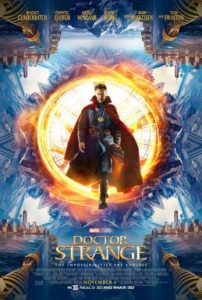 Benedict Cumberbatch casts one helluva spell as an intellectual, cerebral superhero with the ability to shape-shift his surroundings in Scott Derrickson’s Doctor Strange (B), a mostly engaging entry into the Marvel multiverse. The title character is an arrogant surgeon who gets his comeuppance in a crushing car accident and subsequently turns to mystical arts in an effort to heal. Cumberbatch is an unlikely protagonist, but he’s witty, literate and believable in a world in which the supernatural stakes mount mightily. Like Tony Stark/Ironman, his smarminess and smarts with science help his journey take flight. Derrickson cribs from Christopher Nolan a bit too much with secret societies of Asian warriors and Inception style city bending, but the overall vibe is cunning and imaginative. If anything the pace could have been picked up in Kundun style monastery sequences. The effects of hopping out of one’s body make for some giddy multitasking fight sequences, and the hero’s CGI cape should win best supporting costume. Tilda Swinton commands her every mesmerizing sequence as a trippy bald sorceress in a mustard-colored frock. Rachel McAdams and Chiwetel Ejiofor don’t get much to do as an ER doctor and fellow warrior, respectively; and Mads Mikkelsen is menacing as a baddie who looks like he just finished a bender at the discotheque. But it’s really the casting of the central role that’s the coup de grace of this time and space oddity.
 An epic true tale of faith has met its match in a filmmaker for whom fire and brimstone are merely a prelude, and the power and singularity of his vision on screen cannot be denied. Director Mel Gibson’s Hacksaw Ridge (B) is a tough mudder of an action movie, hearkening to the actor-turned-director’s own roots in Peter Weir’s WWI classic Gallipoli and imprinted with a world-weary POV applied to WWII’s Battle of Okinawa. Funneled through Gibson’s prism of gore and glory, the film is far from subtle but nonetheless audaciously moving. At the center of the proceedings – and key to its believability – is Andrew Garfield’s knockout portrayal of real-life American hero Desmond Doss, whose Christian beliefs prompted him to become a conscientious objector to violence simultaneous to enlisting in the military as a medic without a gun. Opening sequences feel like a Whitman’s Sampler of giddy nostalgia that would give Forrest Gump a run for his money in treacly sweetness. But soon after dispensing with some basic training melodrama, the film quickly detours into a fog and slog of war and a series of difficult decisions and riffs on themes of sacrifice and redemption. The director is adroit at putting the viewer in the heart of the action, relating to the protagonist’s fear and faith of being disarmed in the face of encroaching force. Aside from casting Vince Vaughn against type as a droll drill sergeant, the filmmaker rounds out his ensemble with sterling British and Australian actors ranging from Sam Worthington to Hugo Weaving to a relative newcomer, the delightful Teresa Palmer. The images of war are among the most suspenseful and sensational committed to screen, with the titular ridge, flanked with a mountain-high netting leading infantry to setbacks and triumphs, among the splendid set pieces. The sheer duration of some of the sequences dull their impact, but the fight choreography is second to none. Many will love the film’s messages but be turned off by the graphic violence; others repelled by Gibson will miss out on a poignant story. The auteur has once again found the pulse of an incredible and inspiring brave heart.
 Written and directed with poignancy and grace, Barry Jenkins’ Moonlight (A) is urgent in telling a three-chapter coming of age story of a young African-American man named Chiron and how his experiences growing up in America (largely in a surreal pastel drenched Miami) shape his identity. Rather than tackle only the physical violence associated with most inner-city dramas, the perceptive Jenkins traverses the emotional landscapes of self-worth, racial identity and sexuality and how Chiron learns to find traces of comfort in his own skin. The writer/director has fashioned a very dynamic narrative around a shy and withdrawn protagonist; as embodied by three supremely talented actors – Alex Hibbert (child), Ashton Sanders (teen) and Trevante Rhodes (young man), viewers will ache for him to come to answers. Naomie Harris is devastating as Chiron’s emotionally abusive addict mother, and Mahershala Ali is magnificent as a drug dealer who takes on a role as a near-spiritual guide. The film explores the games people play with each other and with themselves in their quest for acceptance. The clues aren’t easy to discover as the film employs an overall tone of heartache punctuated with bursts of uplift, but the journey is consistently gripping. Based on a play by Tarell Alvin McCraney, the film is splendid and assured cinema with an austere and stunning score by Nicholas Britell and a dreamlike color palette created by cinematographer James Laxton and colorist Alex Bickel (first chapter emulates Fuji film stock to emphasize skin tones followed by Afga film stock adding cyan and the final chapter in Kodak form). This is a must-see for cinephiles and is moving indeed as it pinpoints exactly why this Black life matters, expanding consciousness and empathy, and how the people who come into our lives shape our evolving selves.
 Mick Jackson’s Denial (C) doesn’t do cinematic justice to a true-life tale of an American professor who has to defend herself in British courts for defaming a Holocaust denier. Rachel Weisz isn’t quite compelling enough, a serpentine Timothy Spall isn’t given adequate on-screen time and the court proceedings seem rather perfunctory. A trip to Auschwitz death camps provides some powerful context about history, forensics and the nature of truth. The story is a bit of a less literary Inherit the Wind with few surprising flourishes. With topics of this much gravitas, it just didn’t feel like the filmmakers’ passions were fully ignited.
 Somewhere on the cinematic patriarchs continuum between Captain von Trapp and the Great Santini, Viggo Mortensen gives a sensitive, soulful and indelible portrayal of a flawed but well-meaning dad in Matt Ross’ incredibly engaging Captain Fantastic (A-). Mortensen is the draw here, summoning a rugged loner charisma that at this point can just be called “Mortensenesque” as a man raising his six children off the grid in the mountains of the Pacific Northwest with unconventional techniques to teach them self-sufficiency, critical thinking, peak physical performance and a global worldview. His headstrong homeschooling, an ongoing ropes course and debate society in the woods, wins him no favor with his in-laws (well played by Frank Langella and Ann Dowd) but makes him a hero in the eyes of his neo-hippie children, all beautifully played. George MacKay is an earnest delight as the oldest of the offspring, incredibly moving as he experiences a date for the first time after being shrouded in the wilderness. Ross makes an assured directorial and writing debut, showcasing the central family’s confrontations with society in a way that keeps you guessing of whether or not it will all work out. There was a melancholy moment I thought would be a pensive ending, but I liked the extended epilogue – including an unforgettable family jam session – even more. The film is a cult sensation challenging American mores in the tradition of Easy Rider and Into the Wild and highly recommended.
 Usually the mere thought of a new entry into the mockumentary series pioneered by writer/director Christopher Guest brings a sly smile to the face. Alas the funny auteur’s Mascots (D+), a direct-to-Netflix take on furries who get fans in a frenzy, doesn’t get animated nearly enough. Perhaps after exploring theatre, dog shows, movie awards and folk music, the format is getting stale. The overall ensemble lacks energy, and the story has a paucity of punch. The lack of central protagonists or and major plot momentum lead to a ho-hum competition devoid of drama. Jane Lynch and Ed Begley Jr. get some of the best moments; but like all the others, their character arches aren’t sustained. Favorites Parker Posey and Jennifer Coolidge are wasted. Guest even uncorks his own cherished on-screen character from
 Reclaiming the title of D.W. Griffith’s controversial classic is the most subversive element of Nate Parker’s otherwise straightforward historical 2016 retelling of Nat Turner’s 1831 Virginia slave uprising, The Birth of a Nation (B-), but the timing of this true-life tale could not be more prescient given continuing struggles with race in today’s society. Because the protagonist is both slave and scholar and an active preacher, the film brings up big themes about the nature of vengeance. It doesn’t always fuse those themes into a consistent tone, though. For a first time writer/director also in the lead role, Parker is a bit over his head; and his passable acting is largely enhanced by the gravity of his character and because he is opposite a very wooden Armie Hammer as the plantation owner (with unwieldy beard and novelty teeth). Hammer has evolved very little since his leaden
 Justin Kelly’s King Cobra (D+) is a mystery thriller with little mystery or thrills. Set in 2006 as YouTube was coming of age, the film purports to bring a Boogie Nights type allure to the goings-on behind the firewall of an adult film industry in transition. Newcomer Garrett Clayton plays a fresh faced Californian who gets swept up into the porn industry by a closeted amateur producer who makes movies out of his innocuous suburban home, played by Christian Slater. Meanwhile, James Franco and Keegan Allen play rival provocateurs who seem to be acting in a completely different movie universe, like Magenta and Columbia with a death wish. Kelly clearly believes his work is sexier and edgier than it turns out to be. Aside from Slater’s occasionally unhinged performance, there’s very little worth watching here. Fans of Clayton, who is featured in NBC’s Hairspray Live, will get the eye candy they seek but little substance.
 Tate Taylor’s The Girl on the Train (C-) knocks off the time-hopping narrative structure of
 Soon after their latest collaboration
 Jesse Plemons and Molly Shannon might not be anyone’s first casting choices as a gay comedy writer and his dying mom, respectively; but boy are they a moving and marvelous duo in Chris Kelly’s alternately hilarious and heartbreaking melodrama Other People (B+). Plemons, masterfully playing a sad sack hybrid of Matt Damon and Philip Seymour Hoffman, anchors the film as a young man having a very bad year, unlucky in love and work and summoned home from NYC to Sacramento to care for his ailing mom. Molly Shannon is a force of nature as an idiosyncratic and intuitive mother fighting an aggressive bout with cancer. The film’s structure is basically a year in the life, but it colors outside the lines in splendid and droll ways. Like Terms of Endearment and other classic tearjerkers, the ache is earned. Folks will appreciate Bradley Whitford as the stoic father and June Squibb and Paul Dooley as eccentric grandparents. A smart script and surprising characters make this an offbeat indie worth watching.
 Scott Sheppard’s documentary An Act of Love (B) is the powerful account of United Methodist pastor Frank Schaefer who challenged convention by officiating his son’s same-sex marriage ceremony despite church doctrine. Sheppard delves deep into the heart of an American family and far into the bureaucracy – where strictures further complicate scriptures – that hinders societal advancement in an otherwise progressive institution. It’s a sensitive and sensible look at the clash between family and faith. Schaefer makes a compelling central subject in a story that continues to unfold in trials and conversations beyond the screen.