

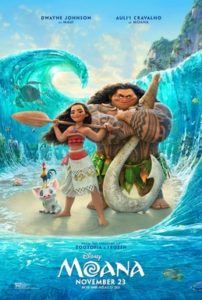
 Co-directors John Clements and Ron Musker have animated quests with more Herculean tasks, drawn crooning crabs making a bigger undersea splash and created caves with greater wonders than the adventure afoot in Moana (C+), their mostly adrift Disney Polynesian epic wannabe. It’s quite enchanting to look at, at least for the first act; and newcomer Auli’i Cravalho brings lovely life to the brave and modern title character. Coupled with a goofy demigod convincingly acted and sung by Dwayne Johnson, the heroine embarks on an ill-conceived odyssey marked by listless villains, average banter and misbegotten mishaps. There’s one good song (of seven) played several times in the film, a propulsive anthem by Hamilton‘s Lin-Manuel Miranda called “How Far I’ll Go,” but alas its prescient title begs the answer “too far” or “not far enough.” The most inventive use of tattoos since Memento and a creative battalion of Mad Max style pirate ships cannot lift the story to the gravitas to which it sometimes aspires. Bogged down in bluster and with story conceits which fail to differentiate it in the Disney kingdom canon, the film is barely better than its makers’ Treasure Planet and The Great Mouse Detective. The co-directors have found unexpected box office success but might have been better off leaving this journey in the bottle.

 Rufus Norris’ adaptation of the West End musical London Road (B) is a curious case of hybrid musical documentary. This syncopation of vérité verse attends the tale of the plainspoken citizens of Ipswich, England, changed forever in 2006 by a quintet of killings of prostitutes who had emerged as curbside phantoms on the scene of a benignly neglected, sleepy borough. Actresses Olivia Colman and Anita Dobson lead an ensemble of sturdy players who brilliantly sing-speak the actual lines of a forensic investigation and subsequent media coverage of the aftermath of the murders, bringing humanity to the random viciousness befalling domestic tranquility. Even Tom Hardy, the most internationally recognized star in the film, has a nice singing bit as a roguish taxi driver tossing out conspiracy theories. Through the vocals of the victimized women living on the margins of town, we learn a little about the irony of a neighborhood watch wary for certain infractions and blind to a city’s most aching needs. Despite the chilling subject matter, there’s an overriding spirit of nihilistic dark comic glee that the filmmakers are having such a good time reinventing how a musical can take shape. Although recorded live, the dulcet dialogue has a delightful dubsmash quality with “ums” and “you knows” treated like they’re the angelic utterances of Jackie Evancho. The asymmetrical, casual quality of the music recalls Dancer in the Dark or Dr. Horrible’s Sing-Along Blog and makes this essential viewing for fanatics of the musical form in its perpetual evolution or of droll, defiant British storytelling. The narrative sometimes yearns to break forth a bit more from its mumblecore melodies and doesn’t really ever make that leap. It would have been interesting to see how an Alan Parker or Ken Russell would have dabbled with more forceful visual panache into this subject matter. As it stands, Norris has challenges honing in on the exact plum protagonists most worthy of our attention. And the procedural story isn’t quite shocking or special enough to warrant this passionate a cinematic treatment. Still, this unconventional yarn is a thrilling detour from traditional storytelling.


 In music and in life, synching up is half the battle. For the two lovers orbiting and intersecting with each other through Richard LaGravenese’s adaptation of the Jason Robert Brown musical The Last Five Years (A), the language of tough love is song, and the deck is shuffled with her story told backward and his forward. The “he” is Jeremy Jordan, and the “she” is Anna Kendrick, and both are in spectacular voice and game for the virtually all-sung emoting. Kendrick’s struggling actress character draws from the actress’ considerable charms and everywoman humor. Jordan is also stunning in his debonair dismissiveness as an on-the-rise novelist whose fame is ablaze just as Kendrick’s character crashes and burns. With hand-held aesthetic and its cunning chronology, it’s a bit like Once meets Memento, with shades of young love out of the Before Sunrise playbook and a found footage quality à la Blair Witch. There’s something else afoot here: a giddiness teetering to melancholy and an overarching uncertainty about where it’s all headed. It does seem clear from the opening sequence that the titular timeline doesn’t end well for the couple, but in still life and snapshots within the various montages, there’s enduring hope. A breezy indie spirit imbues the affair with a veritable home movie quality, with the audience a voyeur to a relationship always on the brink. LaGravenese is scrappy and uncommon in his approach, which rewrites many of the rules of the genre. Naturalistic and unexpectedly moving, it’s a marvel of a musical.


 Chris Buck and Jennifer Lee’s animated Disney movie Frozen (B+) mixes up the princess formula with some unexpected twists and largely enchanting results. This Scandanavian storybook adventure is filled with fresh ice effects, compelling heroines, charming sidekicks and winning songs by Kristen and Bobby Lopez. Kristen Bell and Idina Menzel’s power ballads and a snowman’s serenade to sunny climates – by Book of Mormon‘s Josh Gad – are among the highlights.
 As a movie musical, Tom Hooper’s Les Miserables (A) gets nearly every sonic and emotional note right. Hugh Jackman, Eddie Redmayne and Anne Hathaway are the standout performers in this silver scall-singing spectacular that toggles between moments both intimate and epic. Fans of the theatrical show will have a lot to love, and the modest revisions nearly all serve to clarify the story in its cinematic translation. Themes of rebellion and redemption ring true through the urchins, anthems, baritones and barricades of a gangbuster movie musical.


